Official sources verified on October 8, 2026.
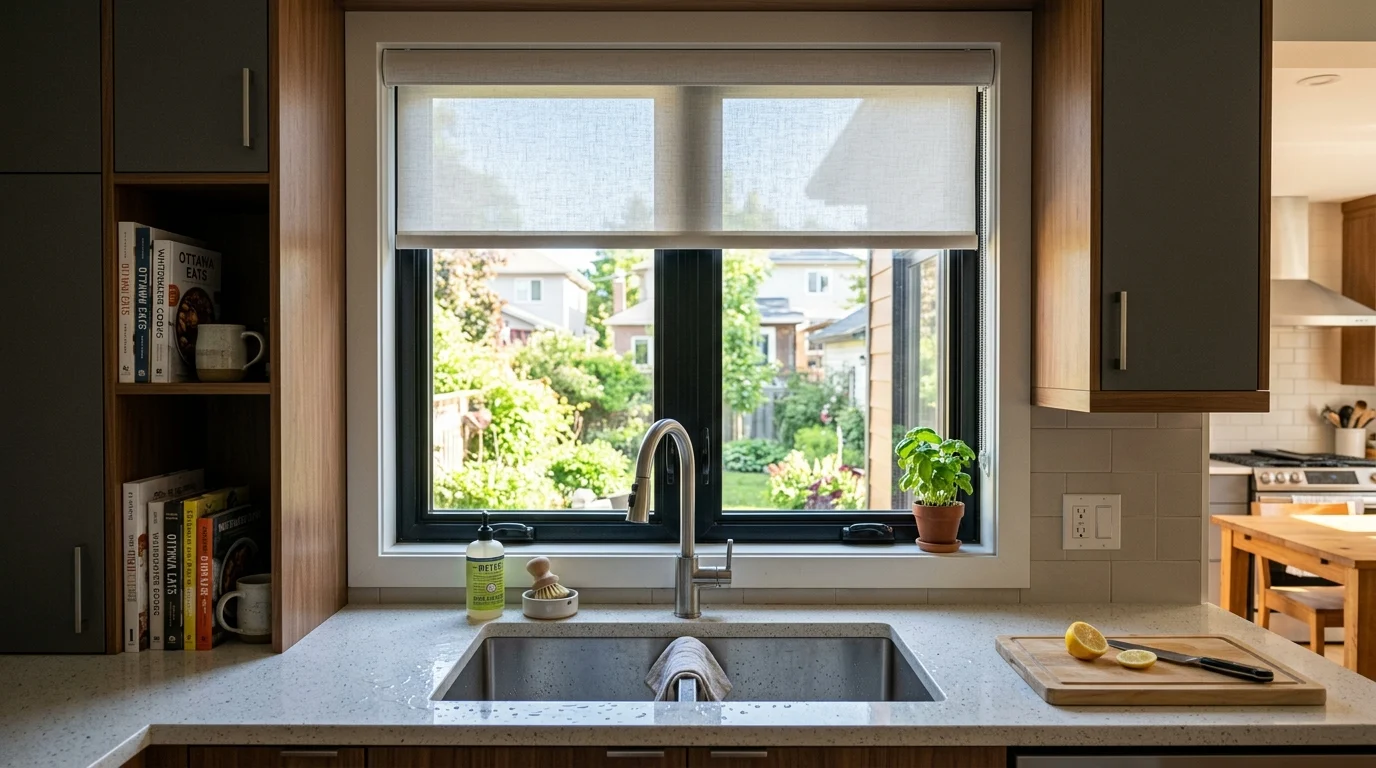
The best waterproof kitchen blinds and moisture-resistant bathroom window coverings in Canada are custom cordless roller shades crafted from 100% moisture-impermeable, PVC-free technical polyester with an anti-microbial coating. For windows situated directly above kitchen sinks, these shades require an inside mount casing depth of at least 2.5 inches to clear gooseneck faucets and adjacent upper cabinet doors, while providing wipe-clean resistance to airborne cooking oils, hot water splatter, and bathroom steam peaks exceeding 85% relative humidity.
Unsure About Splash Resistance or Fabric Texture in Your Kitchen?
Order up to 5 Free Waterproof Fabric Swatches from Zenith Shade, delivered directly to your Canadian home in 3–5 business days. Test water run-off, wipeability, and opacity against your kitchen countertop and morning window light before finalizing your custom order.
Why Standard Window Coverings Fail in Canadian Kitchens and Bathrooms
Kitchens and bathrooms present the harshest indoor microclimates in any Canadian home. Throughout long winters in Ontario, Quebec, and Western Canada, exterior glass temperatures frequently plunge below -20°C while indoor boiling pots, simmering pans, and hot showers create intense thermal gradients. Under these conditions, conventional window treatments deteriorate rapidly through three distinct failure modes:
- Moisture Absorption and Mold Infiltration: Standard woven cotton, linen, and untreated poly-blend fabrics absorb atmospheric moisture like a sponge. When trapped against cold window glass, residual organic matter fosters black mold (Stachybotrys chartarum) within 48 to 72 hours, permanently staining the fabric fibers.
- Aerosolized Grease Vaporization: Frying oils and cooking vapors do not remain in the skillet; they aerosolize into microscopic grease droplets that drift across kitchen ceilings and bond to window treatments. On textured horizontal slats, this creates a sticky film that traps dust and requires abrasive chemical scrubbing.
- Thermal Warping and Slat Degradation: Inexpensive PVC faux-wood blinds and low-grade vinyl mini-blinds soften and deform when placed near cooktops or baseboard heaters. Prolonged exposure to steam causes composite cores to delaminate, bow in the center, and yellow over time.
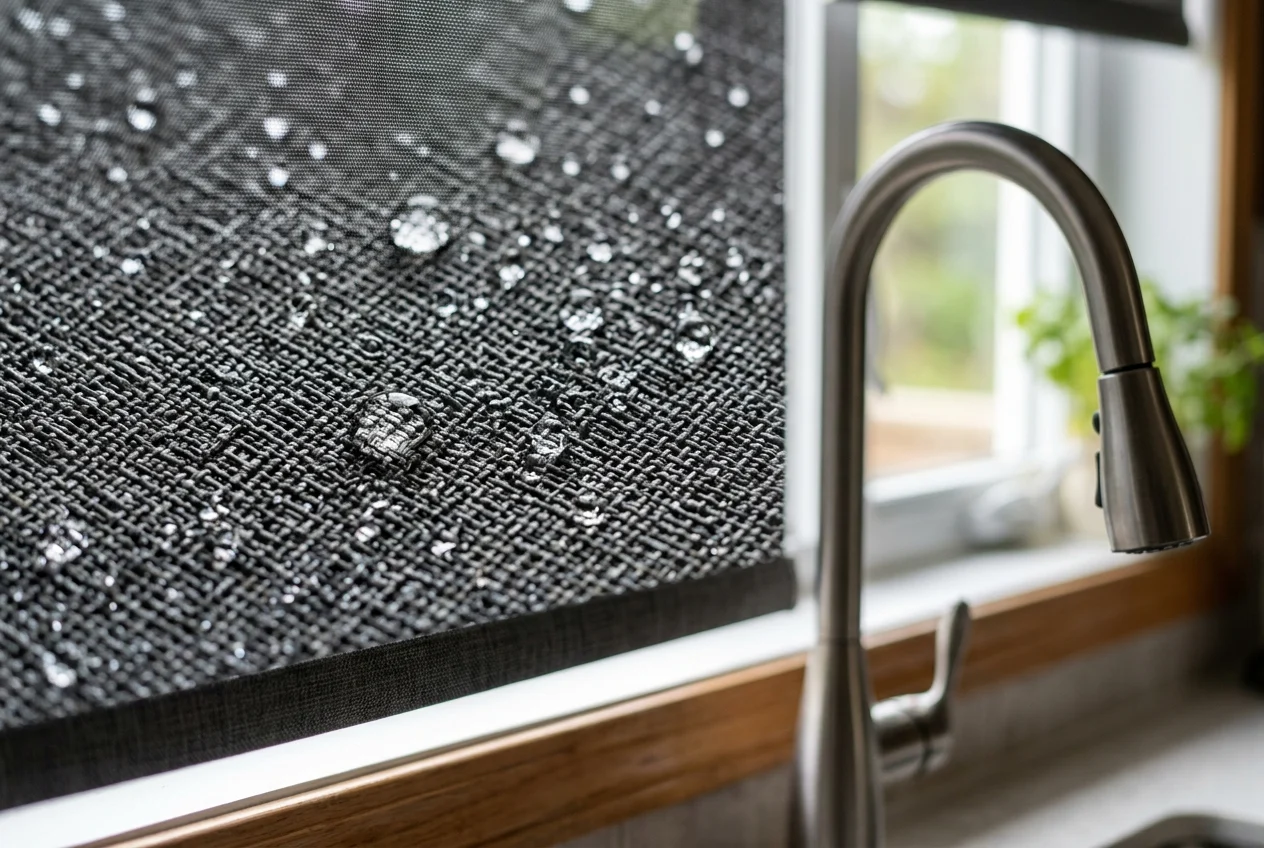
Installing dedicated waterproof kitchen blinds engineered with non-porous surface coatings eliminates these failure points, providing a barrier that repels water beads and allows sticky cooking residues to lift away with a single damp cloth pass.
Material Comparison: What Makes a Blind Truly Waterproof and Grease-Resistant?
Many retail products marketed as “moisture-tolerant” are merely water-resistant, meaning they tolerate occasional ambient humidity but degrade under repeated direct water spray or hot oil droplets. To make an informed investment, Canadian homeowners must evaluate the chemical composition and surface engineering of competing materials.
| Material Category | Waterproof Rating | Grease Wipeability | Heat & Warp Resistance | Mold & Mildew Rating | Typical Canadian Cost |
|---|---|---|---|---|---|
| PVC-Free Coated Polyester (Zenith Shade) | 100% Waterproof (Hydrophobic) | Excellent (1-wipe clean) | High (Tested to 85°C) | Zero growth (ASTM G21 passed) | $95 – $220 CAD per window |
| Traditional Faux Wood PVC Slats | Waterproof on surface | Fair (Traps grease on 40+ slats) | Poor (Warps above 55°C near stoves) | Moderate (Traps grime in rout holes) | $85 – $180 CAD per window |
| Real Hardwood Blinds | 0% (Absorbs moisture) | Poor (Stained by grease) | Very Poor (Cracks & twists) | High risk of rot & mold | $180 – $450 CAD per window |
| Aluminum Mini Blinds | Waterproof (Non-porous) | Difficult (Bends easily when scrubbed) | High (Fire-resistant) | Resistant (Strings absorb mold) | $45 – $110 CAD per window |
1. High-Density Technical Polyester with Polyurethane Backing
Modern custom roller blinds engineered for culinary and sanitary zones utilize a high-density synthetic polyester substrate encased in a microscopic polyurethane or acrylic sealant. Unlike old-fashioned vinyl, this material contains zero plasticizers, avoiding the brittle stiffness and chemical odor associated with cheap PVC. The resulting fabric is completely impervious to liquids, highly resistant to UV degradation, and meets international air quality benchmarks including Greenguard Gold and OEKO-TEX Standard 100.
2. The Pitfalls of Horizontal Slats Above the Kitchen Sink
While faux-wood horizontal blinds resist moisture damage, their mechanical geometry makes them impractical directly above a kitchen sink or near a range. A standard 36-inch window fitted with 2-inch horizontal slats contains 18 to 22 individual surfaces, plus ladder cords and bottom rails. When aerosolized grease bonds with airborne dust, cleaning requires wiping each slat individually on both sides—a tedious 45-minute chore. In contrast, flat architectural roller shades provide a continuous, vertical plane with zero horizontal ledges for grease accumulation.
Designing for High-Risk Zones: Sink, Stove, and Bathroom Surrounds
Window placement determines the mechanical and chemical stresses your window treatments will encounter. Tailoring the specification to specific exposure zones prevents premature replacement.
Zone A: Blinds Above Kitchen Sink
Installing blinds above kitchen sink windows involves navigating constant dishwashing spray, aggressive soap suds, and tall faucet hardware. Standard residential sink faucets stand between 8 and 12 inches high, but modern pull-down commercial gooseneck faucets frequently reach 16 to 21 inches above the countertop deck.
To avoid interference, the window covering must roll upward completely clear of the faucet’s arc. A smooth cordless roller shade with an enclosed aluminum cassette headrail tucks away neatly into a 3-inch profile at the top of the casing, ensuring unobstructed headroom during food prep and dishwashing.
Zone B: Cooktop Proximity and Grease Vapor Management
Windows located within 36 inches of a gas or induction cooktop require strict fire and grease compliance. In Canada, window treatments adjacent to heat appliances must comply with flame propagation standards such as CAN/ULC-S109 or NFPA 701. Synthetic fabrics treated with fire-retardant chemistry will self-extinguish when removed from an open flame. Furthermore, grease-resistant coatings prevent unsaturated fats from penetrating the internal fibers, allowing stubborn cooking oil splatters to be wiped away using warm water and pH-neutral degreasing dish soap.
Zone C: Bathroom Window Shades and Shower Condensation
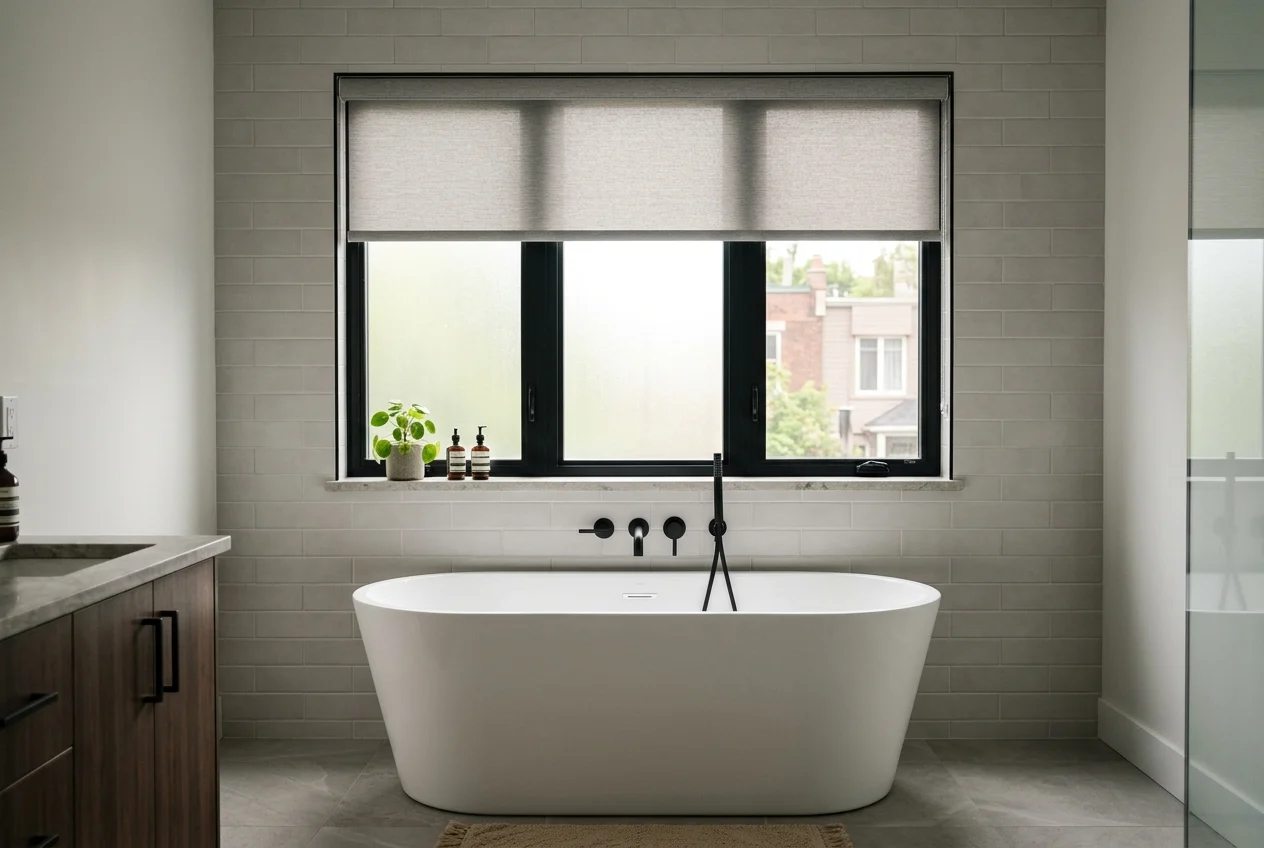
Selecting bathroom window shades in Canada requires balancing total visual privacy with high-humidity resilience. During a 15-minute winter shower, relative humidity in a typical 60-square-foot bathroom spikes from 40% to 95%. When exterior temperatures are well below freezing, window glass becomes an active condenser for moisture.
For complete privacy in ground-floor bathrooms or dense urban condo settings, 100% waterproof blackout fabrics provide zero silhouette visibility under backlighting. If daylight illumination is desired while preserving privacy, translucent moisture-proof privacy fabrics diffuse natural light while blocking outdoor sightlines entirely.
Inside Mount vs. Outside Mount: Solving Sink Obstacles and Cabinet Door Clearance
Precise mounting geometry is critical when installing blinds near kitchen cabinetry. One of the most frequent installation conflicts occurs when adjacent upper cabinet doors strike the window blind brackets, preventing the cabinet from opening past 80 degrees.
Architectural Millwork Considerations and Cabinet Door Swing
In high-end Canadian kitchen renovations—particularly custom cabinetry projects designed by Montreal millwork specialists like KSI Cuisine Solutions—upper wall cabinets frequently flank the sink window with minimal clearance, often resting within 1 to 2 inches of the window trim. When paired with European concealed hinges (such as Blum 107° or 110° full-overlay hinges), an outside-mounted blind bracket protruding 3 inches from the drywall will directly obstruct the cabinet door swing.
To ensure seamless function between custom millwork and window treatments, observe these clearance benchmarks:
| Mount Type | Required Casing Depth | Upper Cabinet Clearance | Light & Privacy Performance | Best Application |
|---|---|---|---|---|
| Inside Mount (Flush) | 2.5″ – 3.0″ minimum | 100% Clear (Zero obstruction to cabinet swing) | Small light gap (1/2″ per side on rollers) | Standard deep window jambs, modern clean look |
| Inside Mount (Partially Recessed) | 1.5″ – 2.25″ | Requires checking hinge clearance (projects 0.5″–1″) | Small light gap (1/2″ per side) | Shallow drywall returns, casement crank windows |
| Outside Mount (Casing/Wall) | 0″ (No depth needed) | High risk of collision (protrudes 2.75″–3.5″) | Zero light gap (Overlaps frame by 2″–3″) | Windows with zero jamb depth or structural tilt |
Measuring Windows Over Deep Kitchen Counters
Measuring a window positioned behind a 25-inch-deep kitchen counter and a 16-inch undermount sink basin requires care. Leaning across a wet sink can cause inaccurate tape angle readings. Follow these steps for an exact fit:
- Clear the Countertop: Empty the sink basin, sponge holders, and dish racks completely before measuring. Place a solid piece of plywood or heavy cardboard across the sink basin if you need a resting point for tools.
- Use a Rigid Steel Tape Measure: Never use a flexible fabric tailor’s tape. A 1-inch-wide steel tape measure extends across the 3-foot counter opening without bending.
- Measure Three Widths: Measure inside casing width at the top, middle, and bottom. Record all three numbers to the nearest 1/8 inch, and take the narrowest measurement for ordering.
- Check Window Crank Clearance: On casement windows, measure the projection of the crank handle. If the crank extends more than 1.5 inches into the frame reveal, consider upgrading to a folding operator handle or opting for a reverse-roll shade orientation.
For comprehensive step-by-step illustrations, consult our detailed Window Shade Measuring Guide. All custom orders through Zenith Shade include our comprehensive Perfect Fit Guarantee: if your measurements are off by even a fraction of an inch, we remake the blind at no charge.
Health Canada Cordless Regulations: Child Safety Around Water and Heat
Since May 1, 2022, Health Canada’s Corded Window Coverings Regulations (SOR/2019-97) have enforced strict limits on window blind operating mechanisms across Canada. The regulation prohibits any free-hanging cord longer than 22 cm or any loop with a perimeter greater than 44 cm on residential window coverings sold nationwide.
In wet or culinary environments, cordless compliance is especially critical:
- Eliminating Chemical & Grime Traps: Dangling beaded chains and braided cords collect grease, dish soap, and airborne moisture. Over time, cord surfaces foster bacterial growth and leave black rub marks on window jambs.
- Eliminating Entanglement Hazards: In kitchens with breakfast nooks or adjacent bench seating, cordless operation eliminates strangulation risks for young children and pets who climb onto counters or seating.
- Safe Operation with Wet Hands: Modern spring-tensioned cordless lift systems and wand controls allow homeowners to raise or lower shades effortlessly, even with damp or soapy hands, without leaving residue on operating hardware.
Every custom shade manufactured by Zenith Shade is 100% cordless, utilizing internal zero-maintenance spring-assist rollers or precision battery motorized systems that fully comply with Health Canada safety directives.
Canadian Winter Condensation: Managing Moisture Without Ruining Your Blinds
During cold Canadian winters, indoor humidity naturally condenses on cold window panes. In poorly ventilated bathrooms and kitchens, excessive humidity can turn window sills into standing puddles.
During freezing conditions, keep in mind that the colder it gets outside, the lower your indoor humidity should be. As a rough guide, when exterior temperatures drop to -20°C, indoor relative humidity should be regulated between 25% and 30% to prevent persistent window glass condensation.
To protect window jambs and ensure maximum longevity for your waterproof shades:
- Maintain Air Circulation: Avoid leaving roller shades drawn fully to the sill 24 hours a day during cold snaps. Cracking the bottom rail 1 inch above the window sill allows heated interior air to wash across the glass, preventing ice accumulation.
- Run Exhaust Ventilation: Keep range hoods running on low for 10 minutes following stove use, and run bathroom fans for at least 20 minutes following showers.
- Wipe Frame Sills Periodically: While waterproof polyester shades will not rot if they contact condensation pools, standing water on painted wooden window stools can blister casing enamel.
Cleaning and Maintenance: 4-Step Grease and Soap Scum Removal Protocol
Maintaining high-performance waterproof kitchen blinds requires no specialized industrial solvents. A quick 5-minute cleaning routine performed monthly keeps technical fabrics looking factory-new for over a decade:
- Dry Dusting: Lower the blind fully. Use a clean, dry microfiber cloth or an electrostatic duster to remove loose airborne dust particles from the top of the roller tube downward.
- Prepare Mild Cleaning Solution: Mix 1 teaspoon of gentle liquid dish soap (such as Dawn or Sunlight) into 1 litre of lukewarm water. Avoid chlorine bleach, ammonia, abrasive scouring powders, or citrus-based solvent cleaners, which can degrade hydrophobic surface sealants.
- Targeted Wipe-Down: Dip a soft microfiber cloth into the solution, wring it out until damp (not dripping), and gently wipe the fabric in broad horizontal strokes. For stubborn tomato sauce or cooking oil splatters, hold the damp cloth against the spot for 30 seconds to dissolve the dried lipids before wiping.
- Air Drying in Lowered Position: Allow the blind to air-dry completely in the lowered position for 15 to 20 minutes before rolling it back into the cassette. This ensures that no trapped moisture sits between coiled fabric layers.
Frequently Asked Questions About Waterproof Kitchen and Bathroom Blinds
Can you install custom roller shades directly above a kitchen sink?
Yes. Custom waterproof roller shades are the optimal window covering directly above kitchen sinks because their flat, non-porous surface repels water splashes and avoids the 40+ dust-and-grease-catching horizontal ledges of traditional blinds. When installed as an inside mount with at least 2.5 inches of casing depth, they roll up completely clear of tall gooseneck faucets and adjacent cabinet doors.
What window coverings will not grow mold in high-humidity bathrooms?
Window coverings made from 100% synthetic, non-porous materials—specifically polyurethane-coated polyester and sealed aluminum—will not foster mold growth because they contain no organic cellulose for spores to feed upon. Avoid real wood, woven reeds, bamboo, and untreated natural cotton fabrics, all of which absorb shower steam and develop mildew stains within months.
How do I prevent my kitchen blinds from hitting my upper cabinet doors?
Choose an inside mount installation with a minimum window casing depth of 2.5 inches. This recesses the roller tube and brackets completely within the window frame reveal, allowing flanking cabinet doors equipped with standard 107-degree or 110-degree hinges to swing open past 90 degrees without striking the hardware.
Are faux wood horizontal blinds better than waterproof roller shades for kitchens?
No. While faux wood PVC slats will not rot from water contact, their horizontal profile collects airborne cooking grease and dust on dozens of individual slats, ladder strings, and rout holes. Cleaning faux wood blinds in a kitchen requires scrubbing each slat individually, whereas a flat waterproof roller shade can be wiped clean in under 60 seconds.
Can waterproof roller shades handle heat from a nearby cooktop?
Yes, provided the window is at least 24 to 36 inches away from open flames and the shade fabric is certified fire-retardant (NFPA 701 or CAN/ULC-S109). Premium technical fabrics will not soften, warp, or off-gas toxic chemical fumes when exposed to culinary heat, unlike cheap vinyl mini-blinds that distort at temperatures above 55°C.
Are all Zenith Shade kitchen blinds compliant with Canadian cordless safety regulations?
Yes. Every window shade manufactured by Zenith Shade is 100% cordless or motorized, strictly adhering to Health Canada’s Corded Window Coverings Regulations (SOR/2019-97). There are zero exposed dangling pull cords or hazardous loops, making them completely safe for children, pets, and wet hands.
How long does custom fabrication and shipping take across Canada?
Custom orders are precision-manufactured to your exact 1/8-inch measurements within 5 to 8 business days, followed by 3 to 5 business days for tracked ground shipping via UPS or FedEx across Ontario, Quebec, British Columbia, Alberta, and Atlantic Canada. All orders are priced in Canadian Dollars ($ CAD) with zero surprise import customs duties.
What is the Zenith Shade Perfect Fit Guarantee?
If you make a measurement mistake on an inside or outside mount custom order, Zenith Shade will remake your window blind to the corrected size at no charge. We believe homeowners should never feel anxious when measuring their windows for custom window treatments.
Ready to Transform Your Kitchen or Bathroom Windows?
Upgrading your culinary and bath spaces with custom waterproof kitchen blinds elevates everyday functionality, safeguards your home against moisture damage, and provides effortless wipe-clean maintenance. Explore our full collection of custom window blinds in Canada, order your complimentary fabric samples, or speak with our design specialists today.
Request a Free Custom Quote → | Book an In-Home Consultation in Ottawa → | Contact Our Montreal Design Team →