Official sources verified on October 12, 2026.
The best blinds for sliding glass doors are the ones that let people walk through without fighting the fabric: either a treatment that travels sideways with the door (vertical blinds, panel track) or two separate shades, one over the fixed panel and one over the panel that slides. For a standard two-panel door 60, 72 or 96 inches wide, plan an outside mount that overlaps the opening by about 3 inches on each side, leave about 3 inches of mounting surface above the frame, and have the fabric stop roughly 1/2 inch above the floor.
Those three numbers solve most of the problems people have with patio doors. The rest comes down to how often the door gets used, which side it opens from, and whether the handle sticks out far enough to catch a bottom rail.
See the fabric against your own patio door first
Order up to 5 free fabric swatches from Zenith Shade, delivered anywhere in Canada in 3–5 business days. Hold them against the glass in morning and evening light to check colour, opacity and how much of the yard you can still see.
If the doors sit beside a wide fixed picture window, our guide to blinds for large windows explains size limits and how to split wide glass into several shades.
Why a Sliding Glass Door Is Harder to Cover Than a Window
A window blind goes up and down, and nobody walks through it. A patio door is a doorway first. Someone lets the dog out, carries groceries in from the deck, or steps out to the barbecue, often several times a day. Whatever covers the glass has to get out of the way quickly, and it has to survive being brushed by shoulders, paws and laundry baskets.
One Canadian window-fashion brand puts the core problem plainly in its door guide: traditional shades that operate top to bottom “may not be the best fit for sliding doors that open and close side to side.” Another major brand gives the same advice from the other direction, recommending that a vertically oriented treatment “traverse in the same direction as your door, side to side.”
There are four other things that make a door awkward:
- The handle. Sliding-door handles project from the frame or the glass. A blind mounted inside the opening can hit it, and a bottom rail can swing into it every time the door moves.
- The width. A two-panel door is already 60 to 96 inches across, and three- and four-panel doors run much wider. One piece of fabric that size gets heavy and can be awkward to lift by hand.
- The floor. Window blinds stop at a sill. Door blinds stop just above a floor, a threshold or a mat, and fabric that drags will wear and catch.
- The frame. Most sliding doors have little flat depth inside the frame, because the track and the door panels fill it. That pushes most installations to the wall above the door.
Standard Sliding Glass Door Sizes and What They Mean for Blinds
Patio doors come in a fairly short list of sizes, and the size decides how many blinds you need. One Ontario door supplier’s size guide lists standard sliding-door widths of 60, 72 and 96 inches for two panels, 108 and 144 inches for three panels, and 144 or 192 inches for four panels. Standard heights are 80, 82 and 96 inches.
Measure your own door before ordering anything. Older homes, renovations and custom builds often land between those sizes, and trim adds width on every side.
| Door type | Common widths | Common heights | What usually works |
|---|---|---|---|
| Two-panel slider | 60, 72 or 96 in | 80, 82 or 96 in | Two side-by-side shades, one vertical blind, or one panel track |
| Three-panel slider | 108 or 144 in | 80, 82 or 96 in | Two or three shades split at the mullions, or a split-draw vertical or panel track |
| Four-panel slider | 144 or 192 in | 80, 82 or 96 in | Three or four shades, usually motorized and grouped, or a centre-split panel track |
| French patio door (hinged) | 48 to 96 in; 72 x 80 in is the most common | Varies; 80 in is common | One shade per door leaf, mounted on the door itself or with clearance for the swing |
Door sizes from an Ontario door supplier’s published patio door size guide (June 2025). Recommendations are Zenith Shade’s.
A 72-inch two-panel door is a good example. Each glass panel is a little under half the frame width once you take out the frame and the centre interlock. Two shades, each sized to cover one panel plus the overlap on its outer side, meet roughly over the interlock. The person walking through only ever raises the shade on the side that slides.
Five Ways to Cover a Sliding Door, Compared
There is no single right answer here. Verticals and panel track are built for doors; roller, zebra and cellular shades are built for windows but work well on doors when they are split. Zenith Shade makes the second group, so we will say which is which as we go.
| Option | How it opens | Door access | Light and privacy | Best fit |
|---|---|---|---|---|
| Vertical blinds | Vanes rotate, then draw to one or both sides | Good once fully drawn | Vanes tilt for privacy with some light | Busy doors, tight budgets, rental units |
| Panel track | Wide fabric panels slide on a multi-channel track | Good once drawn | Depends on fabric; solar to blackout | Wide openings, modern rooms, room dividers |
| Split roller shades | Two shades lift independently | Good on the active side | Solar, light filtering or room darkening | Clean modern look, condos, glare control |
| Split zebra shades | Bands align for view or privacy; shade lifts | Good on the active side | Daylight and privacy without raising the shade | Living and dining rooms facing a yard or street |
| Split cellular shades | Honeycomb shade lifts | Good on the active side | Light filtering or room darkening | Cold doors, bedroom walkouts, basements |
Vertical blinds
Vertical blinds are the traditional choice for sliding doors, and there is a reason for that: the vanes tilt for light and privacy, then stack to the side. They can stack left, right or split down the middle. One online retailer’s door measuring guide notes that “most vertical blinds covering sliding glass doors are installed as outside mounts,” and adds a useful warning: a vertical blind made exactly the width of the opening “will still cover part of the glass when it is fully open,” because the stacked vanes take up room. If you want clear glass, the headrail has to extend past the opening on the stacking side.
The downside is the look and the noise. Vanes clack in a breeze, a pet can bend one, and the dated office feel puts many people off. Fabric-vane and sheer versions soften this.
Panel track
Panel track uses wide flat panels of fabric hung from a track with several channels. Each panel slides behind its neighbour, so the stack is much narrower than drapery. Panels can open from the left, the right or the centre. One Toronto manufacturer describes its panel track as made for “wide windows, sliding glass doors, or creating room partitions,” with wand or motorized control.
Panel track needs a little more planning than other options. A major manufacturer’s measuring guide for sliding panels lists the minimum depth for a flush inside mount at 1 11/16 inches for a two-channel track and 2 3/4 inches for a four-channel track, which is more depth than most patio door frames have. Most panel tracks go on the wall.
Two roller shades instead of one
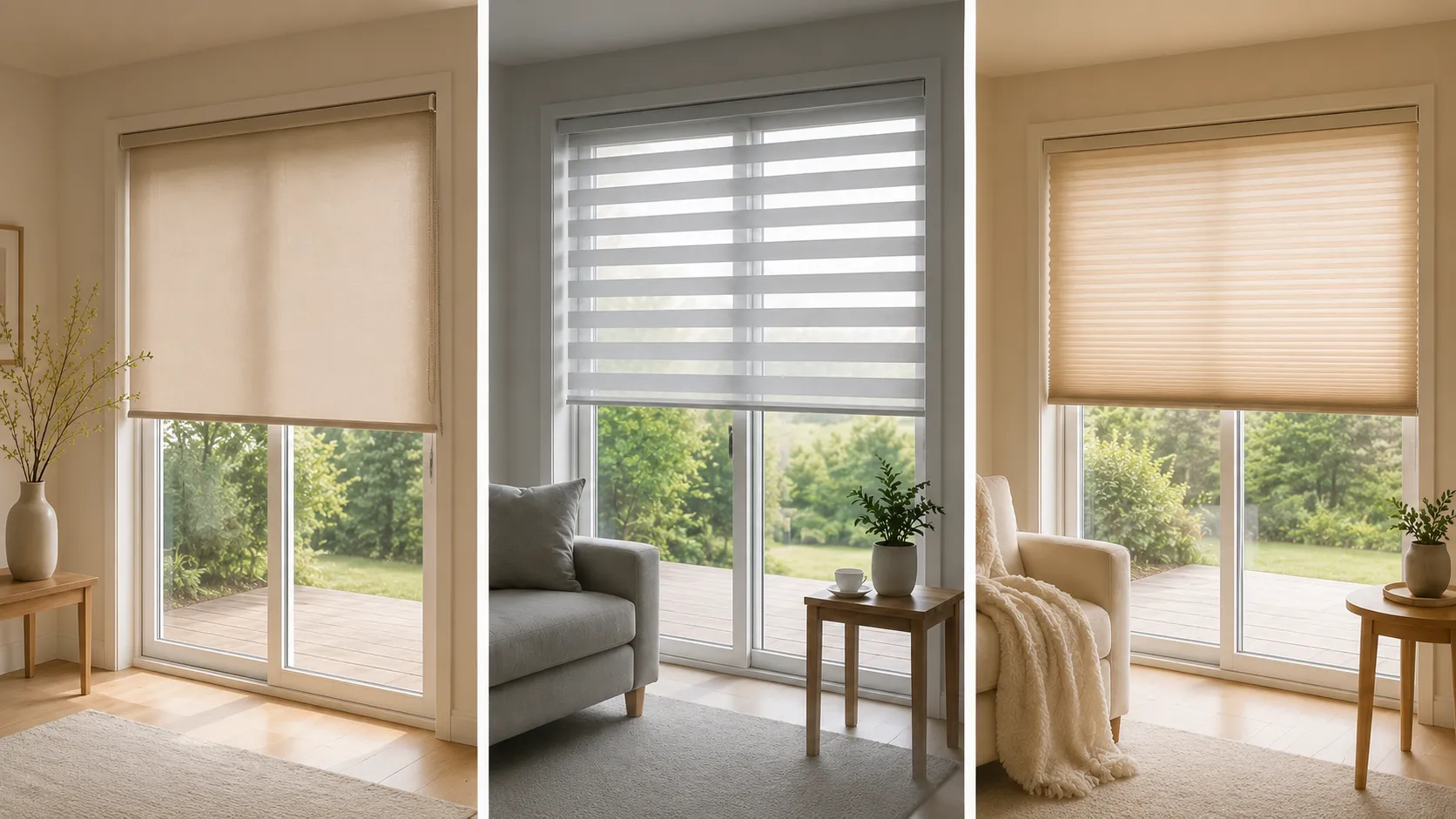
This is the setup we recommend for most two-panel sliders. One roller shade covers the fixed panel; a second covers the operating panel. During the day the shade over the door sits fully up and the fixed side stays wherever it suits the room. At night both come down. Our custom roller blinds come in solar, light filtering and room-darkening fabrics, and the single flat panel keeps a wide opening looking calm.
Two shades also means two smaller, lighter shades. That helps with cordless lifting and with fabric tracking straight on the tube.
Zebra shades on a patio door
A zebra shade has alternating sheer and solid bands on a double layer of fabric. Line the sheer bands up and you see the yard; offset them and you get privacy. On a door that faces a neighbour’s deck or a street, this lets you leave the shade down most of the day and still get light. You only raise it fully on the operating side when someone walks through. See our zebra blinds page for fabric options.
Cellular shades for a cold door
Patio doors are big sheets of glass, and in an Ottawa January the area in front of one can feel noticeably cooler than the rest of the room. A honeycomb shade traps air in its cells and sits closer to the glass than a vertical blind. At least one large brand makes a cellular shade that runs sideways for this reason. Most cellular shades, ours included, lift vertically, so on a door they work best split in two, with the operating side raised during the day. Our cellular blinds come in light-filtering and room-darkening fabrics.
What about drapery?
Drapery on a long rod is the softest option and works with any of the above. Retail measuring guides warn that fabric “can occupy significant space when stacked,” so leave wall space at the ends of the rod, or the open drapes will cover part of the glass. Stationary side panels are decorative and need another treatment behind them to block light.
Split the Door: Why Two Blinds Usually Beat One
People often ask for one blind across the whole door because one blind sounds simpler. In daily use, two works better on most two-panel sliders. You only move the shade you walk through, so the fixed side can stay down for privacy or glare while the door side is up. Each shade is narrower and lighter, which makes it easier to lift by hand and easier on a cordless spring.
The split also hides well. Centre it over the interlock between the two door panels and the small gap between shades sits in front of the frame, where there is no glass to leak light. And because the shades are separate, the fabrics can differ: a room-darkening shade on the fixed side with a light-filtering shade on the door side works well in a bedroom walkout.
The one case where a single shade makes sense is a narrow 60-inch door that is rarely opened, such as a door onto a Juliet balcony or a deck that is closed for the winter. For three- and four-panel doors, line each shade up with a mullion so that every seam sits over a frame.
Measuring Blinds for Sliding Glass Doors
Measure twice, and measure for the mount you will actually use. Our window shade measuring guide covers the basics: use a steel tape, measure to the nearest 1/16 inch, and write down handles, locks, trim and anything else that sticks out. Doors add a few extra steps.
| What to measure | Outside mount allowance |
|---|---|
| Width | Opening or trim width plus about 3 in on each side (6 in total) for light control and privacy; 2 to 3 in per side is a common starting point |
| Stacking side (verticals and panel track) | Extra width beyond the overlap so the stack clears the glass; the amount depends on the product |
| Mounting area above the door | About 3 in above the frame for the headrail, with at least 2 in of flat surface |
| Height to floor | Measure from the headrail position to the floor; the fabric ends about 1/2 in above the floor |
| Handle | How far it projects from the glass or frame |
Allowances from published manufacturer and retailer measuring guides for sliding panels and vertical blinds. Final sizes depend on the product you choose.
Width: overlap the opening
On an outside mount, the blind covers more than the opening. A major manufacturer’s sliding-panel guide recommends a 3-inch overlap on each side “for optimum light control and privacy,” and says to add more than that if you want the treatment to clear the glass completely when it is open. The retailer’s door guide works through an example: a door with trim 72 inches wide gets 3 inches added on each side, for a starting width of 78 inches.
When you split a door into two shades, apply the overlap to the outer edges only. Where the two shades meet over the centre interlock, they should sit close together with a small gap so they do not rub.
Height: above the frame, short of the floor
The sliding-panel guide allows “3 inches for adequate mounting area above the window” and asks for at least 2 inches of flat surface for the brackets. For patio doors, measure from where the headrail will sit down to the floor. The same guide deducts 1/2 inch for roller, solar and Roman fabrics so the fabric does not drag, and the retailer’s door examples also end the vanes about 1/2 inch above the floor. If there is a raised threshold or a thick mat, measure to that instead.
The handle
No guide we checked gives a single handle clearance number, because handles vary so much. Measure how far your handle sticks out from the glass and the frame, and tell us. The practical test is to make sure the treatment “will have sufficient clearance to move and rotate freely.” An outside mount on the wall above the door usually clears the handle without any fuss. If the trim or a deep handle is in the way, projection brackets or spacer blocks bring the shade forward; manufacturers list both for door installs.
Inside mount on a sliding door?
It is possible only when the frame has a deep, flat head jamb in front of the door track. Most do not. If yours does, measure the width at the top, middle and bottom and use the narrowest. Our article on inside mount vs outside mount blinds explains how depth affects each product.
French patio doors are different
A hinged French door swings into the room, so a shade mounted on the wall above it blocks the swing or gets hit by it. The usual fix is one shade per door leaf, mounted on the door itself. Manufacturer guides note that French door treatments often need extension brackets or spacer blocks for clearance and sometimes a cutout around the handle. Shutters on a bi-fold track are another option if you have room; one manufacturer says that needs “at least a couple feet of space.” Our guide to blinds for French doors covers sizing, handles and hold-downs in detail.
Cords, Kids and Pets on a Door People Walk Through
A patio door is a high-traffic spot. Children play near it, cats sit by it and dogs wait at it, which makes cord safety more important here than on most windows.
Canada’s Corded Window Coverings Regulations (SOR/2019-97) set strict limits for any cord a person can touch. A reachable cord with a free end must not exceed 22 cm when pulled with a force of 35 newtons, and any loop must not exceed a perimeter of 44 cm. Every corded product must carry a strangulation hazard warning telling owners to remove it if a longer cord or larger loop becomes accessible.
The Window Covering Safety Council recommends that only cordless window treatments be used in homes with infants and young children, and notes that “almost every type of corded window fashion is now available in a cordless style.” If you have an older corded vertical blind on your patio door, the Council also offers retrofit kits.
On a patio door, the cordless choices are a wand (common on verticals and panel track), a spring-assisted cordless lift on roller, zebra and cellular shades, or a motor. Our guide to cordless blinds and Health Canada’s rules goes through each.
Motorized Blinds for Sliding Glass Doors
Motorization is worth considering on three- and four-panel doors, and on any door where a shade has to go up and down every time someone goes out. A motor lifts a wide shade evenly, removes every cord and chain, and lets a three- or four-panel door move as one group from a single remote.
A few practical uses:
- Set the shades over the door to rise at a fixed time each morning so the dog can be let out without anyone touching fabric.
- Lower a west-facing door’s shades on a schedule before the late-afternoon sun hits the floor and furniture.
- Group all shades on a wide slider so one button opens the room.
All three Zenith Shade product lines can be ordered with a motor. Our motorized blinds page explains the control options, from a handheld remote to app and smart-home control.
Winter Glass, Condensation and Your Patio Door
In a Canadian winter, the inside face of a patio door can get cold enough that moisture in the room condenses on it, especially near the bottom of the glass and the frame. A shade pulled down tight to the glass all night can slow air movement across that surface. If you see water on the frame in the morning, raise the shade during the day so the glass can dry, and check the humidity in the room.
Choosing by Room
Living room onto a deck or yard. Zebra shades split over the two panels let you keep the view during the day and get privacy at night with one pull. If glare on a TV is the main issue, a solar roller fabric on the fixed side helps.
Kitchen or dining area. This is usually the busiest door in the house. Keep the operating-side shade simple and easy to wipe, and make sure the shade clears the handle by a comfortable margin, since it gets grabbed with wet or greasy hands. A motor on the door side means nobody has to touch the fabric at all.
Bedroom walkout or basement walkout. Room-darkening roller or cellular fabric on both sides, with the overlap at the full 3 inches per side. Light leaking around the edges is what wakes people up, so a generous overlap matters more here than anywhere else.
Condo balcony door. Many condo doors run floor to ceiling next to an equally large window wall. Matching the door shades to the window shades in the same fabric and headrail keeps the room looking like one wall of glass. Check your building’s rules before you buy.
How to Order Blinds for a Sliding Door from Zenith Shade
- Order up to 5 free fabric swatches and hold them against the door in morning and evening light.
- Decide on one shade or a split, and which side the door slides from.
- Measure width, height to the floor, mounting area above the door and handle projection, using our measuring guide.
- Send the numbers and a photo of the door with a quote request, or book an in-home consultation if you are in the Ottawa area. French-language support is available for customers in Montréal.
Every order is backed by our Perfect Fit Guarantee. Browse the full custom blinds range to compare all three products side by side.
Frequently Asked Questions
What are the best blinds for sliding glass doors?
The best blinds for sliding glass doors are either a treatment that moves sideways with the door, such as vertical blinds or panel track, or two side-by-side shades so only the walk-through side has to be raised. Split roller, zebra or cellular shades suit modern rooms, and the right fabric depends on whether you want view, privacy or darkness.
Should blinds for a sliding door be inside or outside mount?
Outside mount, in almost every case. Most sliding door frames lack the flat depth an inside mount needs, and an outside mount above the frame clears the handle more easily. Plan for about 3 inches of overlap on each side and about 3 inches of mounting area above the door.
Can you put roller blinds on a sliding glass door?
Yes. Use two roller shades, one over the fixed panel and one over the operating panel, so the door side can be raised on its own. A single roller shade across the whole door works on narrow doors that are rarely opened, but it has to be fully raised every time someone walks through.
How far should a patio door blind be from the floor?
About 1/2 inch above the floor for roller, solar and similar fabrics. That stops the fabric from dragging on the floor or catching on the threshold. If you have a thick mat or a raised sill, measure to that surface instead.
How much wider than the door should the blind be?
About 3 inches wider on each side, or 6 inches in total, for an outside mount. For vertical blinds and panel track, add more on the side where the vanes or panels will stack so the stack clears the glass when open.
Are vertical blinds out of style for patio doors?
Not entirely, but many homeowners now choose fabric alternatives. Plastic vanes are durable and usually the least expensive option, though fabric verticals, sheer verticals, panel track and split zebra or roller shades give a softer, more current look.
Are cordless blinds required on patio doors in Canada?
No rule names patio doors specifically, but the federal Corded Window Coverings Regulations (SOR/2019-97) cover indoor corded window coverings. Any reachable cord with a free end can be no longer than 22 cm, and any loop no larger than 44 cm around. Cordless and motorized shades avoid the issue entirely, and that matters most on a door children and pets pass every day.
Do motorized blinds work on a wide sliding door?
Yes, and they are one of the best uses for a motor. A motor lifts a wide shade evenly, and several shades over a three- or four-panel door can be grouped on one remote or schedule. All Zenith Shade roller, zebra and cellular shades can be ordered motorized.