Official sources verified on October 18, 2026.
The best blinds for large windows are roller blinds for clean, wide coverage and cellular blinds where winter comfort matters most, with zebra blinds as the daytime-privacy option for living rooms. Once an opening passes about 72 inches wide, the hardware starts to drive the decision: one wide shade needs a bigger tube and a heavier clutch or motor, while two or three narrower shades side by side stay flatter and lighter but leave thin light gaps between them. Published manufacturer specs put single manual roller shades at up to 192 inches wide and motorized coupled systems at up to 240 inches, while the retail lines we checked stop at 110 to 120 inches, so the right answer depends on your exact width.
This guide covers windows in Canadian homes and condos that are wide (picture windows, living room walls of glass) or tall (two-storey great rooms). Patio doors and bay windows have their own guides: see blinds for sliding glass doors and blinds for bay windows.
Blinds for Large Windows at a Glance
Start here if you only need the short version. The “watch for” column is where large windows behave differently from standard ones.
| Blind type | Best for on large glass | Watch for | Sold by Zenith Shade? |
|---|---|---|---|
| Roller blinds | Wide picture windows, condos, offices; the slimmest look across a long run of glass | Waves and edge curl grow on very wide panels; tube size must match width | Yes, manual or motorized |
| Cellular (honeycomb) blinds | Cold rooms, bedrooms, north-facing walls of glass | Retail listings we checked cap width at 120 in; headrail needs only 2 to 2 1/2 in of depth | Yes, manual or motorized |
| Zebra blinds | Living and dining rooms that want daylight and privacy in one product | Light filtering only, never full blackout; band alignment matters across multiple shades | Yes, manual or motorized |
| Dual roller system | Rooms that need a sheer by day and a darker fabric at night on the same window | Deeper hardware; check frame depth before choosing inside mount | Yes (roller only) |
| Vertical blinds and panel tracks | Very wide spans and doors, where fabric moves sideways | Different look and stacking space at the side | No: Zenith Shade does not make these |
See the fabric against your own glass first
Order up to 5 free fabric swatches from Zenith Shade, delivered anywhere in Canada in 3–5 business days. On a large window the fabric becomes the biggest surface in the room, so hold each swatch against the glass at midday and again after dark with the lights on.
What Counts as a Large Window, and Why 72 Inches Matters
For blinds, a window becomes “large” at the point where the hardware has to change. On one manufacturer’s published roller shade specifications, that point is 72 inches: the smallest manual clutch (with a 1 1/8-inch tube) covers widths from 12 to 72 inches and a maximum fabric weight of 8 lbs, and anything wider moves to a larger clutch and a 1 1/2- or 2-inch tube rated for 16 lbs (Hunter Douglas Architectural roller shade technical drawings).
Height has its own threshold. On the same spec sheet, the main manual clutches all top out at a 144-inch drop (12 feet), while the motorized systems listed go to 192 inches (16 feet). If your window is taller than 12 feet, you are almost certainly looking at motorization, whatever the width.
Appearance changes too. Lutron’s shade aesthetics guide notes that “as shade width increases, typically over 108 in. (2743 mm), waves and edge curls tend to increase,” and that taller shades show more edge curl and waves as well (Lutron, Shade Aesthetics, Rev A 04/08). So a 9-foot-wide roller shade can work, but it is more likely to show a slight ripple than a 5-foot one.
How Wide Can One Blind Go? Published Size Limits
One blind can cover far more width than most people expect, but only on the right system. The figures below come from manufacturer and retailer pages opened on October 18, 2026. Treat them as examples. Every product line, fabric and mount sets its own maximum, and heavier blackout fabrics usually reduce it.
| System (source) | Width range | Height (drop) | Notes |
|---|---|---|---|
| Manual roller, small clutch, 1 1/8 in tube (Hunter Douglas Architectural) | 12–72 in | up to 144 in | Max shade weight 8 lbs |
| Manual roller, mid clutch, 1 1/2 or 2 in tube (Hunter Douglas Architectural) | 72 1/8–120 in | up to 144 in | Max shade weight 16 lbs |
| Manual roller, heavy clutch, 2 1/2 in tube (Hunter Douglas Architectural) | 120 1/8–156 in | up to 144 in | Max shade weight 40 lbs |
| Manual roller, largest clutch, 3 in tube (Hunter Douglas Architectural) | 156 1/8–192 in | up to 144 in | Spring assist option listed |
| Motorized roller, coupled bands (Hunter Douglas Architectural) | up to 240 in total | up to 144 in with fascia | Max 6 bands, each band up to 120 in |
| Motorized roller line (Lutron Sivoia) | 20 in to 20 ft | not stated | Coupling brackets and side channels offered |
| Retail roller line (Envision, sold by Blindsgalore Canada) | up to 110 in on a single tube | not stated | Consumer-grade online product |
| Retail cellular lines (Blindsgalore Canada listings) | up to 120 in | up to 108 in | Applies to the specific listings named on the page |
Two patterns stand out. First, the consumer lines we checked stop at 110 to 120 inches wide, while architectural and motorized systems keep going to 16 or 20 feet. Second, weight ratings climb with width: the rating jumps from 16 lbs on the mid clutch to 40 lbs on the heavy one, which is why very wide manual shades take more effort to pull and why motors become the usual choice at that size.
Zenith Shade does not publish one maximum width for its roller, zebra or cellular blinds, because the limit changes with the fabric and the control you pick. The size check happens during the free in-home consultation, where width, height, depth and access are measured on site before anything is ordered.
One Wide Shade or Several Narrow Ones?
On most windows wider than about 9 feet, splitting into two or three shades gives a flatter, easier-to-use result, and a single shade wins only when an unbroken view matters more than everything else. Lutron’s guide lists “split one wide shade into two or more shades” as one of its fixes for waves and tube sag, alongside a thicker tube and a fabric stiffener called a batten.
| One wide shade | Two or three shades side by side | |
|---|---|---|
| Look when lowered | One uninterrupted fabric panel | Thin vertical lines where shades meet, ideally lined up with window mullions |
| Light gaps | Only at the two outer ends | Small gaps at each shade end; matters in bedrooms |
| Flatness | More prone to waves, edge curl and tube sag past about 108 in | Each panel is narrower, so it hangs flatter |
| Hardware | Larger tube, heavier clutch or motor, deeper roll-up | Smaller tubes; can be coupled to one motor or chain on some systems |
| Daily use | All or nothing | Open one section for view, keep another down for glare or privacy |
| If something fails | The whole window is affected | Only one section is affected |
How big are the light gaps?
Small, but visible against a bright sky. Hunter Douglas Architectural lists the light gap at the control end of a manual roller shade at about 1/2 inch to 7/8 inch depending on the clutch size, and roughly 5/8 inch at the idle end. Two shades butted together therefore leave a combined gap of around an inch or more at the join. Line that join up with a vertical mullion in the window and it mostly disappears. In a bedroom where every bit of light counts, an outside mount that overlaps the frame, or a single wider shade, is the better plan; our room darkening vs blackout blinds guide explains how much light each fabric lets through.
Coupled shades: several panels, one control
Coupling links two or more roller shades end to end so they raise and lower together from a single motor or clutch. On the Hunter Douglas Architectural motorized system, a coupled run can reach 240 inches with up to six bands, no single band wider than 120 inches. You get the flatness of narrower panels with the convenience of one control. Zenith Shade’s roller page describes the same idea for wide glass: hardware aligned across the windows, fabric direction repeated, and motorized control grouped so the whole wall behaves as one system.
Worked Example: A 12-Foot Living Room Window in Ottawa
Take a 144-inch-wide (12-foot) picture window, 72 inches tall, facing west in an Ottawa living room, with two vertical mullions dividing the glass into three equal 48-inch panes. Here are the three realistic options, using the published ranges above.
- One 144-inch roller shade. At this width the spec sheet puts a manual shade in the heavy-clutch range (120 1/8 to 156 inches, 2 1/2-inch tube, up to 40 lbs). It works, but it is heavy to pull, the roll-up at the top is thicker, and the fabric sits in the width range where Lutron expects more waves. A motor is the more comfortable choice here.
- Two 72-inch shades. Each falls in the smallest clutch range (12 to 72 inches). The catch: the join lands in the middle of a pane, not on a mullion, so the light line between them sits right in the centre of the view.
- Three 48-inch shades. Each shade matches one pane, the joins hide behind the two mullions, and you can lower only the west-facing glare section in late afternoon. With a motorized group, all three still move together on one button.
For this window, three shades aligned to the mullions is the cleanest answer. If the wall is shallow and the shades go outside the frame instead, Zenith Shade’s measuring guide suggests 1.5 to 3 inches of overlap on each side, so the total covered width becomes 147 to 150 inches, split across the three shades.
The Best Blinds for Large Windows, by Type
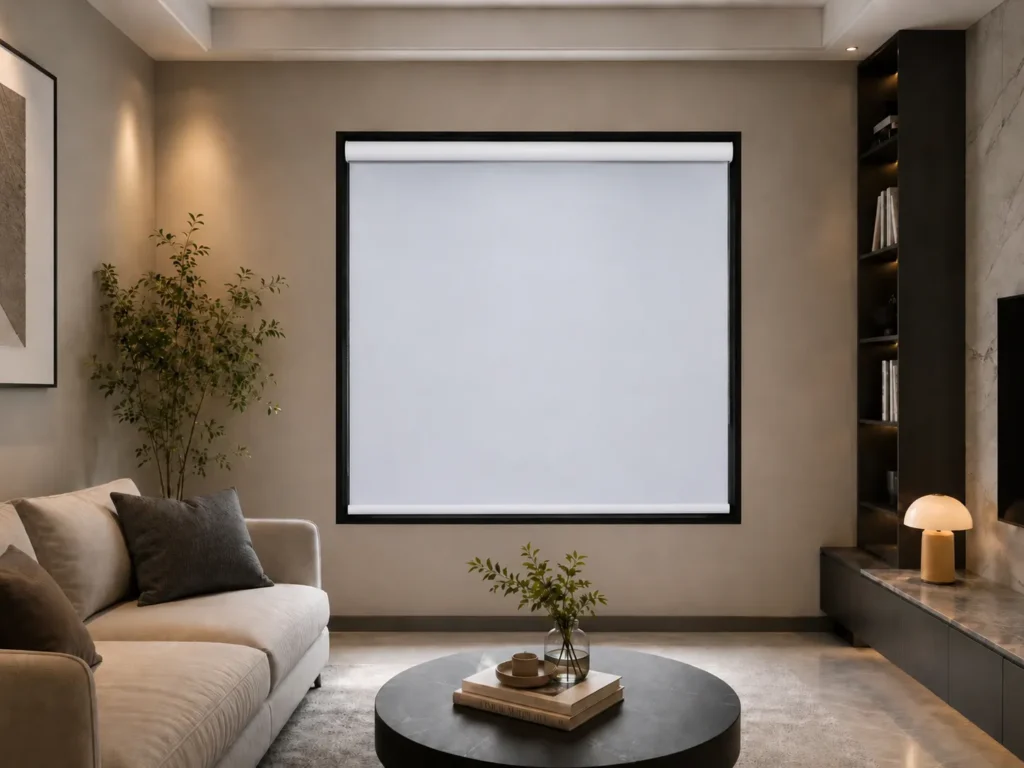
Roller blinds are the default for most large windows, cellular blinds win wherever cold glass is the main complaint, and zebra blinds suit rooms that want daylight and privacy without raising the blind. Zenith Shade’s own custom blinds page names roller or cellular blinds as the best fit for large windows, with grouped motorized control.
Roller blinds: the cleanest line across wide glass
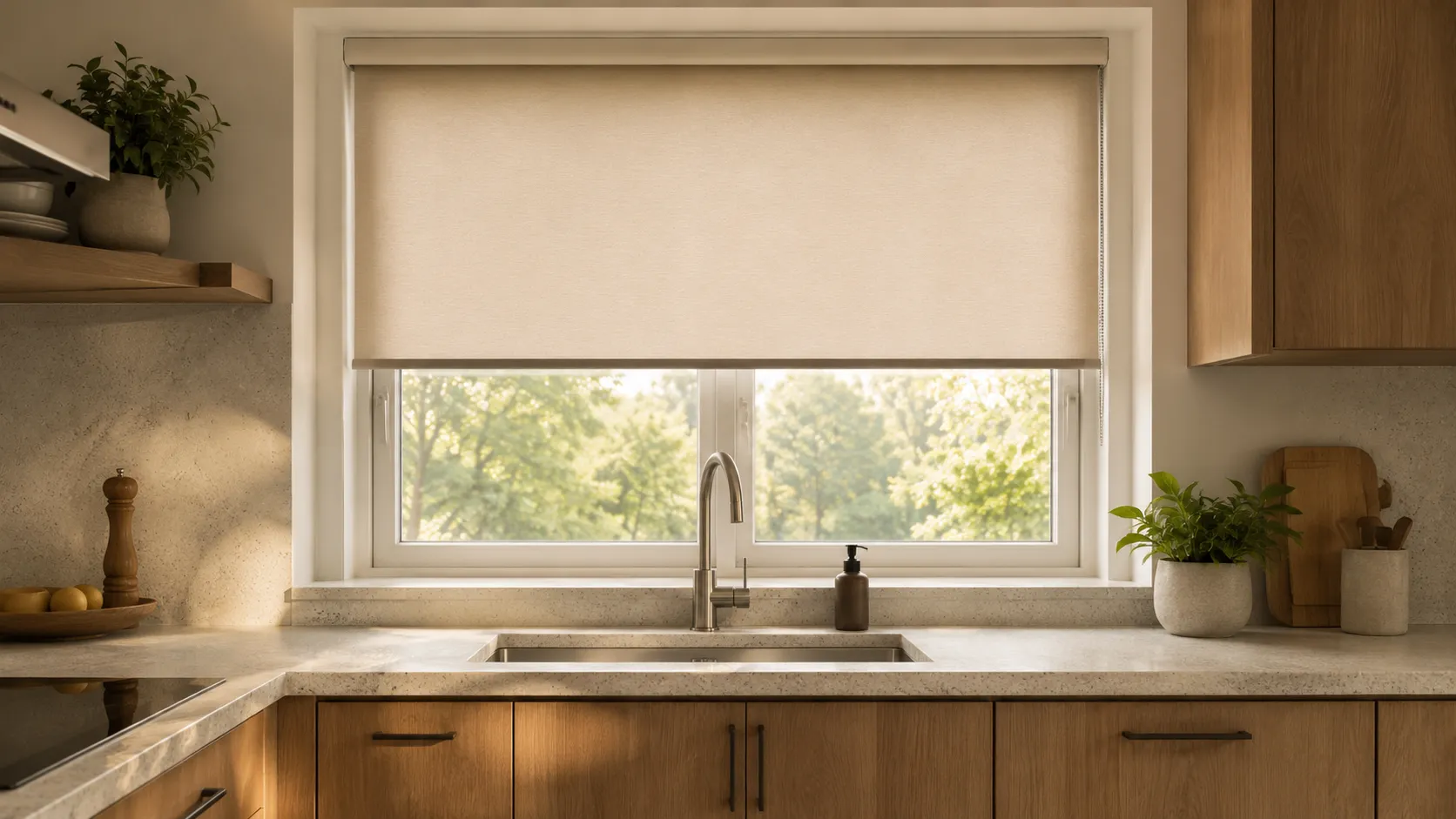
A roller blind is one flat panel of fabric on a tube, so it adds almost nothing visually when raised and reads as a single plane when lowered. That suits condos and modern living rooms with long runs of glass. On large windows, the top finish matters more than usual. An open roll needs about 3 inches of flat depth, a compact cassette about 3 1/2 inches, and a fascia 3 1/2 to 4 3/8 inches, per Zenith Shade’s measuring guide. Zenith describes the fascia as the option that “visually organizes the top of wide or repeated windows”, because one continuous cover hides several tubes behind it.
Roller blinds also offer a dual roller system: two shades on one bracket, typically a light-filtering fabric for daytime and a room-darkening one for night. On a big west-facing window that means you can cut glare at 4 p.m. without losing the view. See fabric and finish options on the custom roller blinds page.
Cellular blinds: for cold glass and bedrooms
Cellular (honeycomb) blinds trap air in their cells, which makes them the most insulating of the three blind types Zenith Shade makes. A U.S. Department of Energy bulletin states that “tightly installed cellular shades can reduce heat loss through windows by about 40%, whereas most average draperies will reduce heat loss by up to 10%” (U.S. DOE, March 1, 2024). The word “tightly” matters: on a large window, side gaps let cold air circulate, so an inside mount with minimal deductions, or an outside mount with generous overlap, gets you closer to that figure.
Cellular headrails are slim, about 2 to 2 1/2 inches deep, so they often fit inside shallow condo frames where a roller cassette would not. The trade-off is width: the retail cellular listings we checked top out at 120 inches, so very wide windows usually need two or more cellular shades. More on the custom cellular blinds page.
Zebra blinds: daylight and privacy in one product
Zebra blinds alternate sheer and solid bands; shift them and the room goes from soft daylight to privacy without raising the blind. On a street-facing picture window that is useful, because you can keep light coming in while blocking the view from the sidewalk. Two cautions for large windows. Zebra blinds are a light-filtering product with no blackout version, so they are a poor choice for a large bedroom window on their own. And when you split a wide window into several zebra blinds, the bands need to line up across all of them, which is why Zenith plans multi-window zebra installs as one system. Compare them directly in zebra blinds vs roller blinds or see the custom zebra blinds range.
Vertical blinds and panel tracks
Many large-window guides recommend vertical blinds or sliding panel tracks, because they stack to the side and cover very wide spans. They are a valid choice, especially across door walls. Zenith Shade does not make either product, so if you have decided on one of them, you will need another supplier. If you want a shade that raises upward instead, the three types above cover nearly every large window.
Heat, Cold and Condensation on Big Glass in Canada
The bigger the window, the more of your heating bill it controls. Natural Resources Canada states that “windows, doors, and skylights can account for up to 35 percent of total house heat loss,” and that curtains and blinds “can help reduce radiant heat loss from windows during the heating season and reduce solar gain during the summer” (NRCan, Keeping the Heat In, Section 8, modified January 14, 2025).
The same NRCan page adds a warning that applies directly to large windows: “as curtains and blinds are not airtight, they may cause window condensation problems in the winter.” A big pane behind a closed blind gets colder, and warm indoor air that slips behind the fabric meets that cold glass. Three habits help:
- Raise the blinds for part of every winter day so the glass warms and dries.
- Keep heating vents under large windows clear; Lutron also notes that air from heating and cooling systems can make a shade sway.
- Watch indoor humidity on the coldest nights and wipe any water off sills before it reaches the frame.
Our guide to whether blinds cause window condensation goes through the causes and fixes in detail.
Why Motorization Matters More on Large Windows
Motorization moves from a nice extra to the practical choice once a blind is heavy, high or one of several on the same wall. The spec figures explain why: a manual shade above 120 inches wide is rated for up to 40 lbs, and manual clutches stop at a 144-inch drop while motorized systems in the same catalogue reach 192 inches. A motor also lets you group three shades on one remote, app or wall switch, so a split window still opens with a single press.
Child safety is the other reason. Canada’s Corded Window Coverings Regulations (SOR/2019-97), in force since May 1, 2021, say a reachable cord with a free end “must not exceed 22 cm in length” when pulled with a force of 35 N, and the perimeter of any loop must not exceed 44 cm. The regulation’s definition of “cord” includes a chain. On a tall window, a manual chain long enough to operate the shade can be hard to keep within those limits, which is one reason large windows are usually ordered cordless or motorized. Our cordless blinds safety guide covers the rules in full.
Before ordering a motor for a large window, plan power early (battery, rechargeable or hardwired) and decide whether you want the shades to join a smart-home system. Zenith Shade’s motorized blinds page covers remote, grouped, timer and app control, and our smart blinds compatibility guide explains Alexa, Google Home and Matter.
Measuring Blinds for Large Windows: A Checklist
Large openings need more measurements than usual, because frames are more likely to be slightly out of square or bowed over a long span. Zenith Shade’s measuring guide asks for a steel tape or laser measure, readings to the nearest 1/16 inch, and the narrowest width recorded for inside mounts.
- Measure width at the top, middle and bottom, and height at the left, centre and right. On very wide windows, add height readings at each mullion.
- Measure the diagonals. If they differ noticeably, the frame is out of square and an outside mount may hide it better.
- Record the position of every mullion from the left edge, so split shades can meet behind them.
- Measure flat mounting depth at several points; the deepest hardware (fascia, at up to 4 3/8 inches) sets the minimum.
- Note cranks, handles, alarm sensors and vents that the bottom rail will pass.
- For outside mounts, decide the overlap (1.5 to 3 inches per side is the guide’s range) and check what is above the frame for bracket fixing.
- For anything above arm’s reach, note ladder access and the nearest outlet for a motor charger or hardwired power.
If you are unsure whether to mount inside or outside the frame, read inside mount vs outside mount blinds first. Zenith Shade’s consultation page notes that large, tall or hard-to-reach windows should be reviewed for ladder access, power planning and motorized operation, so for those windows an on-site check before ordering is worth booking.
Common Mistakes With Large Window Blinds
| Mistake | What happens | Better approach |
|---|---|---|
| Ordering one shade for a very wide window because it “looks cleaner” | Heavy to operate, more waves, thicker roll at the top | Split at the mullions, or motorize the single shade |
| Splitting without checking mullion positions | Light lines land in the middle of the view | Size each shade to its pane |
| Choosing zebra blinds for a large bedroom window | Too much light gets through for sleep | Room-darkening roller or cellular, or a dual roller |
| Measuring width once | Inside-mount shade binds or leaves wide gaps | Three widths, three heights, both diagonals |
| Ignoring frame depth | Cassette or fascia sticks out past the frame | Measure depth first, then pick the top finish |
| Leaving the manual chain long on a tall window | Accessible loop near the floor | Cordless or motorized control |
FAQ: Blinds for Large Windows
What are the best blinds for large windows?
Roller blinds are the most common choice because one flat panel covers wide glass with the least visual bulk. Choose cellular blinds if the window makes the room cold, and zebra blinds if you want daylight and privacy without raising the blind.
How wide can a single roller blind be?
It depends on the system. One retail roller line sold in Canada stops at 110 inches on a single tube, while architectural systems list single manual shades up to 192 inches and coupled motorized runs up to 240 inches. Heavier fabrics lower the limit.
Is it better to use one large blind or two smaller ones?
Two or three smaller blinds usually hang flatter and are easier to operate, and you can open them separately. One blind is better only when an unbroken view or a bedroom with no light lines matters most.
Do I need motorized blinds for a large window?
Not always, but it is the practical choice for windows above reach or taller than 12 feet. Manual roller clutches on one published spec sheet stop at a 144-inch drop, and manual shades over 120 inches wide are rated for up to 40 lbs.
Which blinds keep a large window warmest in winter?
Cellular blinds. A U.S. Department of Energy bulletin says tightly installed cellular shades can reduce heat loss through windows by about 40%, compared with up to 10% for average draperies.
How do you stop light gaps between blinds on a wide window?
Make the shades meet behind a mullion, or mount them outside the frame with overlap. Expect roughly 1/2 to 7/8 inch of gap at each shade end on manual roller systems, so a join between two shades shows about an inch of light unless something covers it.
Are chain-operated blinds allowed on large windows in Canada?
Yes, if they meet SOR/2019-97: reachable cords, chains included, must stay within 22 cm under a 35 N pull and loops within 44 cm. On tall windows that is hard to achieve with a chain, so cordless or motorized control is the safer option.
Summary
For most large windows, roller blinds give the cleanest coverage, cellular blinds keep cold rooms more comfortable, and zebra blinds handle daytime privacy. Past about 72 inches wide the hardware steps up, past about 108 inches waves become more likely, and past 12 feet tall a motor is close to essential. Splitting a wide window into shades that meet at the mullions, then grouping them on one motor, solves most of the problems that come with size. Figures in this guide reflect manufacturer and government pages as of October 2026; they do not describe every product line, and your own window’s limits are set by the fabric and system you choose.
Ready to plan yours? Request a free quote and fabric samples, or book a free in-home consultation in the Ottawa area and have every width, height and depth measured on site.