Official sources verified on October 21, 2026.
The best blinds for basement windows are slim, light-filtering shades that fit a shallow frame and lift completely clear of the glass, because most basement windows are short, wide, set below grade and often hinged to tilt inward. Cellular shades suit frames with only 2 to 2 1/2 inches of flat depth, roller and zebra shades usually need about 3 to 3 1/2 inches or an outside mount, and a bedroom egress window must stay fully openable from the inside without tools. Pick a wipeable fabric, leave a little air gap to limit condensation, and use cordless or motorized control wherever children sleep or play.
This guide covers typical Canadian basement windows (hopper, slider and casement egress windows in poured-concrete or block foundations) as of October 2026, with Ontario Building Code references because Zenith Shade is based in Ottawa. Building rules differ in other provinces, so confirm egress details with your local building department. Zenith Shade makes roller, zebra and cellular shades, manual or motorized. We do not make vertical blinds, wood or faux-wood slats, or shutters; where one of those would suit your window better, this guide says so.
Blinds for Basement Windows at a Glance
Start with the window type and the depth you can mount into. Everything else (fabric, colour, control) follows from those two facts.
| Basement situation | Best-fit shade | Mount | Why it works |
|---|---|---|---|
| Hopper window, shallow frame (about 2 to 2 1/2 in deep) | Cellular, light filtering | Inside mount if depth allows, otherwise outside | Slim headrail fits; fabric stacks small above a sash that tilts in |
| Hopper or slider with a deep drywall return (3 in or more) | Roller or zebra | Inside mount | Clean look inside the opening; enough depth for the roll or cassette |
| Window set high in the wall, little depth | Roller or zebra | Outside mount above the frame | Brackets go on the wall, so frame depth no longer limits you |
| Bedroom egress window | Cordless cellular or roller | Outside mount, stacked above the opening | Raises fully off the glass so the window can open at any time |
| Basement apartment or rental unit | Roller or cellular | Inside mount on the existing frame, or wall mount above | Few screw holes; see our renter-friendly blinds guide |
| Damp corner, laundry or bathroom window | Roller with wipeable fabric | Inside or outside | Smooth fabric wipes clean; see moisture-resistant blinds |
| Media room or bedroom that needs it dark | Room-darkening roller or cellular | Outside mount with overlap | Overlap cuts the light gaps at the sides |
Why Basement Windows Need a Different Plan
Choosing blinds for basement windows is different from choosing them for the rest of the house because of the windows’ shape, their position and the air around them. Three differences matter most.
They are small and wide. Window makers’ published standard sizes for basement hopper windows mostly fall between about 30 and 36 inches wide and 12 and 24 inches tall (as of October 2026). A blind that is three times wider than it is tall behaves differently from a typical living room shade: the bottom rail is long relative to the drop, and the stack at the top takes up a bigger share of a short opening.
They sit at or below grade. Many basement windows look into a window well or straight out at lawn level. Daylight arrives from above at a steep angle, and people walking past look down into the room. That combination usually calls for privacy without losing the little light that gets in.
The air is cooler and damper. Natural Resources Canada estimates that basements can account for about 25 percent of a home’s total heat loss, with a lot of air leakage through basement windows and at the top of the foundation wall. The same NRCan section notes that condensation can form on foundation walls in summer when the air is humid and the concrete is cool. A shade pressed against cold glass in a damp room is exactly where moisture collects.
Choosing the Right Type of Basement Window Blind
For most basement windows, cellular shades are the easiest fit, roller shades are the most practical in damp rooms, and zebra shades give the best balance of privacy and daylight. Here is how each one handles basement conditions.
Cellular (honeycomb) shades
A cellular headrail runs about 2 to 2 1/2 inches deep, which is the slimmest hardware in our window shade measuring guide. That makes cellular the shade most likely to fit inside a shallow vinyl basement frame. The pleated fabric also stacks into a short bundle when raised, which keeps more of a small window clear. The honeycomb cells trap a layer of air, so a cellular shade is the warmest-feeling option on cold basement glass in January. Choose light filtering for family rooms and room darkening for bedrooms.
Roller shades
A roller shade is a single flat sheet of fabric, so it wipes clean and dries quickly, which suits laundry rooms, basement bathrooms and any window where you see condensation in winter. An open roll needs about 3 inches of depth and a compact cassette about 3 1/2 inches. Many basement windows have less than that inside the frame, so roller shades are often mounted outside the frame on the wall above. On a short window, a reverse roll (fabric coming off the front of the tube) can help the fabric clear a crank or latch.
Zebra shades
Zebra shades layer sheer and solid bands, so you can line up the sheer bands to let daylight in while still blurring the view from the yard. That suits a basement family room or home office facing the street. The cassette needs more depth than a cellular headrail, so plan for an outside mount on most basement frames, and remember that zebra fabric is light filtering, not blackout. Our zebra vs roller blinds comparison goes deeper on the trade-offs.
Products we do not make
Aluminium mini blinds and faux-wood slats are common in basements because they are cheap and tolerate damp. Vertical blinds and shutters also turn up in finished basements. Zenith Shade does not make any of these, so if you want slats for a very wet room, a general home store is the place to look. For fabric shades, the three types above cover nearly every basement window.
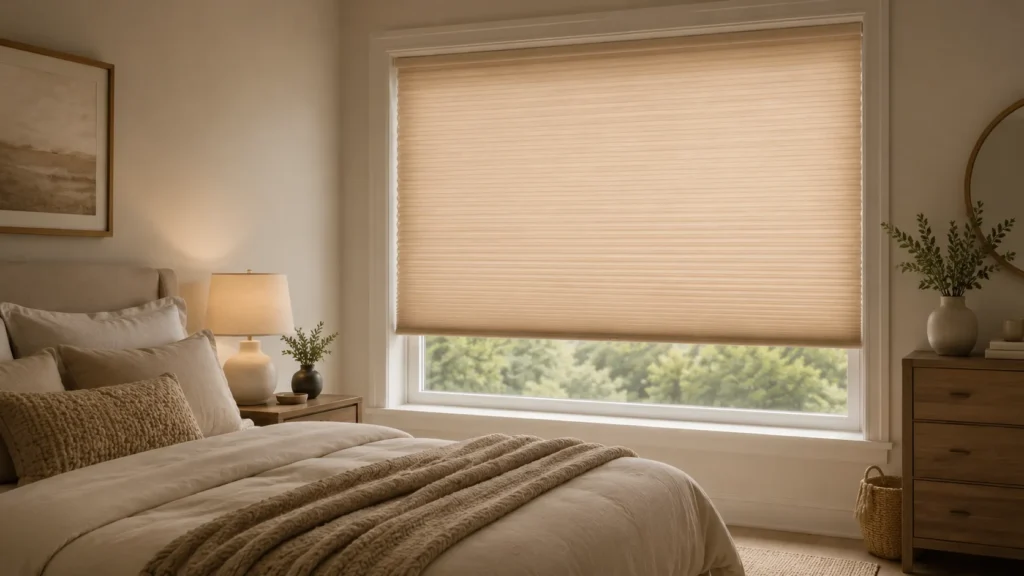
Inside Mount or Outside Mount on a Basement Window
On a basement window, outside mount is the safer default, and inside mount is worth it only when you have enough flat depth and the window does not tilt into the shade. Measure the flat surface inside the frame where the headrail brackets will sit, not the depth to the glass.
| Hardware | Approx. planning depth | Fits a 2 1/4 in deep basement frame? | Notes |
|---|---|---|---|
| Cellular headrail | About 2 to 2 1/2 in | Usually, but confirm | Slimmest option; check the exact system depth before ordering |
| Roller, open roll | About 3 in | No, use outside mount | Can mount on the wall or on the face of the trim |
| Roller, compact cassette | About 3 1/2 in | No, use outside mount | Cassette hides the roll for a tidier look |
| Fascia | About 3 1/2 to 4 3/8 in | No, use outside mount | Best on wide windows where the top needs a finished line |
| Zebra cassette | Confirm with the system | Usually not | Plan outside mount unless the return is deep |
| Motorized roller | Confirm motor and bracket depth | Rarely | Check motor and bracket depth before ordering |
Depth figures come from our measuring guide and are approximate; the exact number depends on the system and fabric you choose. For a fuller comparison, read inside mount vs outside mount blinds.
Watch the sash on hopper windows
Most basement hopper windows are hinged at the bottom and tilt into the room from the top. An inside-mounted shade hangs right where that sash swings. If the bottom rail is down, the sash hits the fabric, and if the shade is only partly raised, the sash catches the bottom rail. Before you choose inside mount on a hopper, open the window fully and measure how far the top of the sash comes into the room. If the headrail and the raised stack cannot sit above that line, mount outside the frame and high enough on the wall that the stack clears the open sash.
Worked example: a 32 x 16 inch hopper window
Say a basement hopper measures 32 inches wide and 16 inches tall inside the frame, with 2 1/4 inches of flat depth, and the sash tilts in about 4 inches at the top when open.
| Step | Calculation | Result |
|---|---|---|
| Check inside-mount depth | 2 1/4 in available vs 2 to 2 1/2 in cellular headrail | Cellular might fit; roller (3 in) and cassette (3 1/2 in) do not |
| Check sash swing | Sash tilts in about 4 in at the top, into the shade’s path | Inside mount would block the window when the shade is down |
| Choose outside mount | Add 2 in of overlap on each side: 32 + 2 + 2 | Shade width 36 in |
| Set the height | 2 in above the frame for brackets and stack, 1 1/2 in below the sill: 16 + 2 + 1.5 | Shade height 19 1/2 in |
| Result | Outside-mounted roller or cellular, about 36 x 19 1/2 in | Shade raises fully above the frame and the sash opens freely |
The measuring guide suggests 1.5 to 3 inches of overlap on each side for an outside mount; 2 inches is a middle value that also blocks most side light. Measure your own window at the top, middle and bottom to the nearest 1/16 inch, because older foundations are rarely square.
Egress Windows: Keep the Escape Route Clear
If a basement bedroom relies on a window for emergency exit, blinds for basement windows in that room must never stand in the way. Choose a shade that lifts fully above the opening in one motion, mount it outside the frame, and skip anything that has to be unclipped or unscrewed before the window will open.
The City of Ottawa’s egress window advisory (reissued August 2025 under the 2024 Ontario Building Code, Division B, Article 9.9.10.1) sets out the requirements for windows that serve a floor level with a bedroom:
| Requirement (2024 OBC 9.9.10.1, per City of Ottawa) | Metric | Approx. imperial |
|---|---|---|
| Unobstructed open area, window fully open | At least 0.35 m² | About 3.77 sq ft |
| Smallest dimension of that opening | No less than 380 mm | About 15 in |
| How it opens | From the inside without the use of tools | No keys or tools |
| Stays open | Holds the opening without additional support | No propping |
| Maximum sill height | 1,000 mm above the floor, except for basement areas | About 39 in |
| Window well in front of the window | 550 mm of clearance | About 21 1/2 in |
| Deep window wells | More than 1,000 mm deep needs a way to help the occupant climb out | Over about 39 in |
The area and the shortest side both have to pass. A clear opening of 500 x 700 mm gives exactly 0.35 m² and passes; 380 x 900 mm has a wide enough short side but only 0.342 m² of area, so it fails. Small hopper windows rarely meet these numbers, which is why basement bedrooms often get a larger casement or slider. The advisory sets the size and operation of the window; it does not mention blinds. The point for your shade is practical: in smoke and darkness, nobody should have to fight a bottom rail, a hold-down clip or a tangled chain to reach the latch.
What that means for the shade:
- Mount outside the frame so the raised stack sits above the opening, not inside it.
- Avoid hold-down brackets at the sill on egress windows; they lock the shade in place.
- Prefer cordless lift or a motor with a manual override so the shade goes up in one motion.
- On a casement, check the crank handle does not snag the bottom rail.
- Keep beds and furniture far enough from the window that the shade and the window can both be reached.
Other provinces, and the National Building Code that many of them adopt, can use different window-well figures. If you are creating a new bedroom or a secondary suite in a basement, your municipality’s building department has the final word.
Light and Privacy in a Below-Grade Room
In most basements you want to keep every bit of daylight and only block the view in, so light-filtering fabric is the usual choice and blackout is reserved for bedrooms and media rooms.
Because light enters a basement window from above and at an angle, a shade that covers only the lower part of the glass, or a sheer fabric, keeps much of it. Zebra shades are useful here: align the sheer bands in daytime, close them at night. Light-coloured fabrics bounce more light back into the room; dark fabrics reduce glare on a TV but make a small window look smaller.
For a basement bedroom, guest room or home theatre, choose room-darkening roller or cellular fabric and mount it outside the frame with overlap, since side gaps on an inside mount let light around the edges. Our guide to room darkening vs blackout blinds explains how dark each option really gets.
At night the situation reverses. With lights on inside, a sheer or light-filtering fabric shows silhouettes to anyone in the yard. If a window faces a walkway or a neighbour’s door, choose a fabric with more opacity or pair a light-filtering shade with a second layer, such as a dual roller system that combines a sheer and a room-darkening fabric on one bracket.
Moisture, Condensation and Cold Glass
A blind cannot fix a damp basement, but the wrong blind can make condensation worse, so give the glass some air and choose a fabric you can wipe.
NRCan’s guidance on windows notes that curtains and blinds can reduce radiant heat loss in the heating season, but because they are not airtight they may cause window condensation in winter. Warm, moist room air slips behind the shade, meets the cold glass and condenses, and with the shade closed there is less airflow to dry it. Basement windows, with cool frames and often higher humidity, are where this shows up first.
Ways to reduce it:
- Raise the shade for part of each day so the glass can dry.
- Leave a small gap between the fabric and the glass rather than pressing the shade tight to it.
- Control humidity with a dehumidifier or exhaust fan, and fix the source of damp (leaks, grading, downspouts) before finishing the room; NRCan’s basement guidance says water problems should be corrected first.
- Choose smooth, wipeable fabric for laundry rooms, bathrooms and any window that drips in winter.
- Check the bottom rail and sill for spotting each month during the heating season.
If mould has already appeared on a shade, clean or replace it rather than putting it back over wet glass. Our guide to cleaning roller, zebra and cellular blinds covers safe methods, and do blinds cause window condensation? goes further into winter frost on Canadian windows.
On a kitchen-adjacent basement window or a basement bar with cabinets close to the frame, check that cabinet doors and the shade’s bottom rail do not collide. The same depth and clearance issues come up above kitchen sinks, which our moisture-resistant blinds guide covers.
Not sure how much light a fabric will let into your basement?
Request free fabric samples from Zenith Shade and hold them against your basement window at midday and again after dark with the lights on. Below-grade light is weak and angled, so a fabric that looks right in a showroom can look much darker at home.
Cord Safety in Basement Bedrooms and Playrooms
Basements often become playrooms, guest rooms and children’s bedrooms, so choose cordless or motorized shades there. Canada’s Corded Window Coverings Regulations (SOR/2019-97), in force since May 1, 2021, say that a reachable cord with one free end must not exceed 22 cm when pulled with a force of 35 N, and any loop must not exceed 44 cm around. The definition of a cord includes a chain.
A low basement window is easier for a small child to reach than a main-floor window, and a crib or bed pushed against the wall under it puts any chain within reach. Keep sleep furniture away from the window, and if you choose a chain-operated shade, confirm it meets the regulation and that the tension device is fixed to the wall. Our cordless blinds safety guide explains what the rules mean in practice.
Motorization is worth considering on basement windows for a different reason: high, small windows above a couch or a counter are awkward to reach. A battery or rechargeable motor removes the chain entirely and lets you raise a group of basement shades together. See motorized blinds for control options.
How to Measure a Basement Window for Blinds
When measuring for blinds for basement windows, work to the nearest 1/16 inch with a steel tape, record width at three points and height at three points, and note the depth and anything that projects into the opening. Basement frames are often out of square, so take the smallest measurement for an inside mount.
- Open the window fully and note which way the sash moves and how far it comes into the room.
- Measure the flat mounting depth inside the frame where brackets would sit.
- For inside mount, measure inside width at the top, middle and bottom and record the narrowest; measure height on the left, centre and right.
- For outside mount, decide the coverage: frame width plus 1.5 to 3 inches each side, plus room above the frame for the brackets and stack.
- Note cranks, latches, locks, a sloped sill, drywall returns or a bulkhead above the window.
- Photograph the window and the wall around it, including any ductwork or pipes nearby.
The Zenith Shade measuring guide has a printable worksheet. If you are in the Ottawa area, a free in-home consultation includes measuring.
Common Mistakes With Basement Window Blinds
Most basement blind problems come from measuring the glass instead of the mounting surface, or from forgetting how the window opens.
- Ordering an inside-mount roller for a frame with only 2 inches of flat depth.
- Mounting inside a hopper window so the sash cannot tilt in while the shade is down.
- Choosing blackout fabric for a family room that already gets little light.
- Pressing a shade against cold glass all winter and finding mould on the bottom rail in spring.
- Using hold-down clips on a bedroom egress window.
- Hanging a chain-operated shade above a crib or a child’s bed.
- Assuming several basement windows are the same size without measuring each one.
Checklist Before You Order
- Window type noted: hopper, slider or casement, and which way it opens.
- Flat mounting depth measured inside the frame.
- Inside or outside mount decided, with overlap planned for outside mount.
- Width and height measured at three points each, to 1/16 inch.
- Egress window identified, with the shade stacking fully above the opening.
- Fabric chosen for the room: light filtering, room darkening or wipeable.
- Cordless or motorized control in any room used by children.
- Moisture source checked and dealt with before the shade goes up.
Frequently Asked Questions
What are the best blinds for basement windows?
For most basement windows, cellular shades are the best fit because their 2 to 2 1/2 inch headrail suits shallow frames and the fabric stacks small. Roller shades are the better pick in damp rooms because the flat fabric wipes clean.
Can you put blinds on small basement windows?
Yes. Small basement windows take custom blinds made to the exact size; the main limits are frame depth and the space the raised stack takes up. If the frame is shallow, mount the shade on the wall just above the window.
Should basement window blinds be inside or outside mount?
Outside mount is the safer choice for most basement windows. Use inside mount only when the frame has enough flat depth for the headrail and the window does not tilt into the shade’s path.
Do blinds on basement windows cause condensation?
They can. NRCan notes that blinds and curtains are not airtight and may contribute to window condensation in winter, so raise the shade for part of the day, keep a gap from the glass and control the room’s humidity.
Can you put blinds on an egress window?
Yes, as long as the shade never blocks the opening. Mount it outside the frame so it lifts fully above the window, and avoid hold-down clips or anything that needs tools to release.
Are blackout blinds good for basement windows?
Only in rooms that need darkness, such as bedrooms and media rooms. In a family room or office, blackout fabric throws away the little daylight a basement gets, so light-filtering fabric is usually better.
Are cordless blinds required in Canada?
No, but corded blinds must meet SOR/2019-97: a reachable cord or chain cannot exceed 22 cm, and loops cannot exceed 44 cm around, when pulled with 35 N. Cordless or motorized shades are the simpler choice in children’s rooms.
Summary
Blinds for basement windows work best when they are planned around the window rather than the room: measure the flat depth, check how the sash opens, and choose a mount that lets the shade lift fully clear. Cellular shades fit the shallowest frames and feel warmest, roller shades handle damp rooms, and zebra shades balance daylight and privacy. Keep egress windows free of clips and stacks, leave the glass room to breathe, and choose cordless or motorized control wherever children sleep. This guide reflects Ontario rules and common window sizes as of October 2026; your own measurements and your local building department take priority.
Ready to plan your basement windows? Request a free quote and fabric samples, or browse all custom blinds to compare fabrics.