A living room window facing a busy Ottawa street doesn’t need the same window covering as a media room where the goal is near-total darkness at two in the afternoon. That’s really what sits behind the question of zebra blinds vs roller blinds — not which product is objectively better, but which mechanism actually matches what a specific window needs to do. Both are custom-made, both can be motorized, and both show up constantly in the same rooms. The difference is in how the fabric moves.
What Are Zebra Blinds?
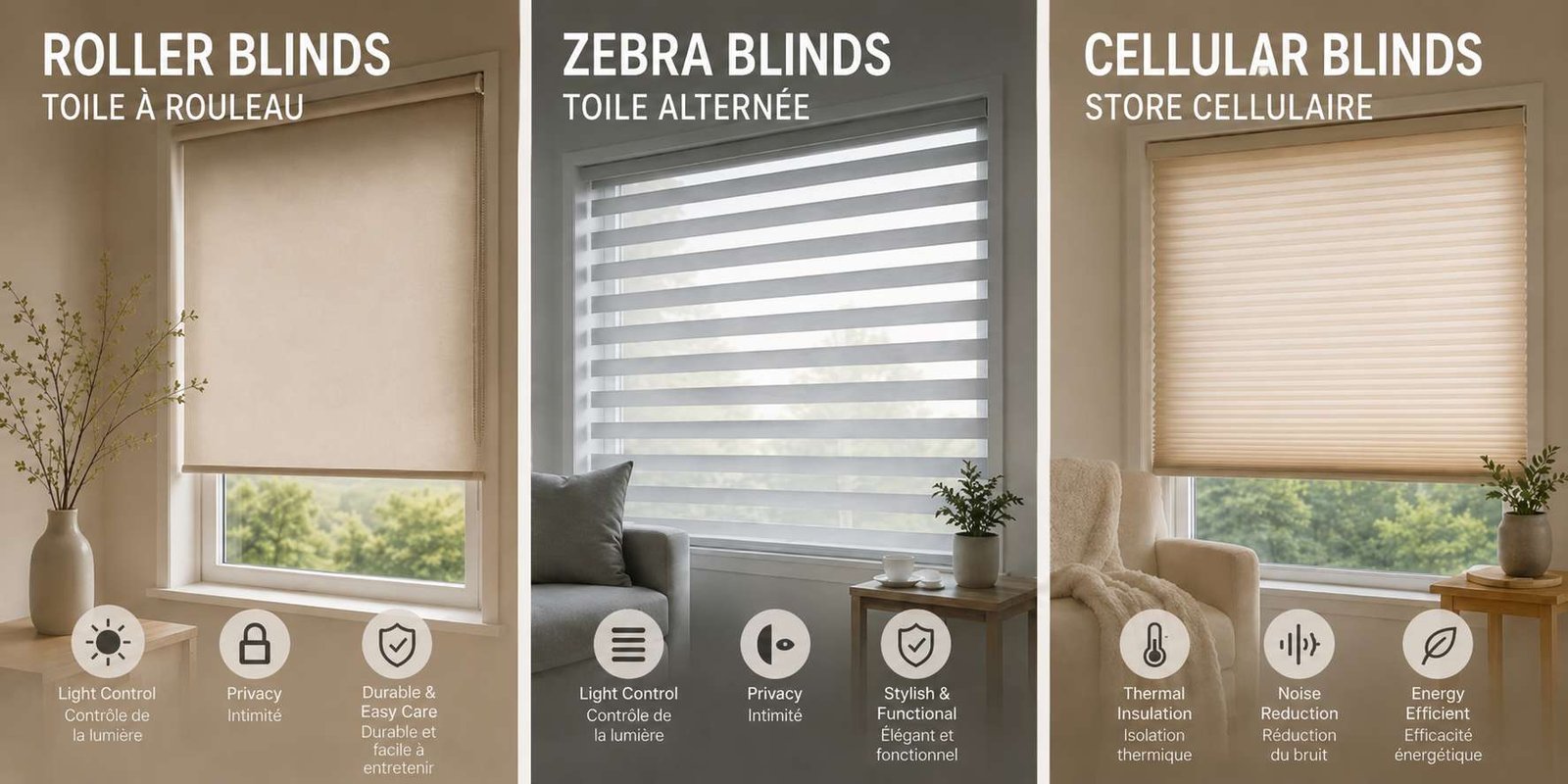
Zebra blinds are built from a single continuous piece of fabric with alternating sheer and solid horizontal bands, looped around one roller tube. Sliding the fabric shifts the bands relative to each other: line the sheer sections up and light filters through the whole window; overlap the solid sections and the window reads almost opaque, without lowering the blind at all. The category goes by several names depending on the manufacturer — Hunter Douglas sells its version as Designer Banded Shades, Sun Glow calls its line Interlude, and “dual shades” or “day and night blinds” show up often enough in product listings that it’s worth recognizing them as the same thing.
Zenith Shade stocks several zebra fabric lines that show this range in practice: PearlMist and CloudLoom lean toward soft, light-filtering neutrals for everyday rooms, while OpalVeil and LinenAura add a heavier linen texture for a more layered look.
What Are Roller Blinds?
Roller blinds are mechanically the simpler of the two: one flat sheet of fabric on one tube, raised and lowered as a single piece. What makes the category flexible is the fabric itself, which ranges from sheer, to light-filtering, to full blackout. There’s no banding and no independent adjustment — the blind is open, closed, or somewhere in between, uniformly across the whole window. That simplicity is also why roller blinds are usually the cheaper of the two mechanisms to manufacture: one layer of fabric, one tube, one seam to finish.
On the roller side, fabric does most of the differentiating: LumaGrid and VellumWeave are common picks for a light-filtering everyday look, while DuneLoom and MoonVeil skew toward warmer tones and blackout-leaning performance.
The Real Difference: Adjustable Light vs. Consistent Coverage
This is where the two products actually diverge. A roller blind gives you one variable: how far down it is. A zebra blind gives you two: how far down it is, and how the bands are aligned. That second variable is the whole appeal — a condo unit on a mid-rise Centretown street can keep the blind fully extended all day and just slide the bands to answer the light and privacy question as the sun moves, rather than raising and lowering the entire blind every time someone walks past the building across the road. A roller blind in the same spot would need to be lowered for privacy and raised for a view; there’s no middle setting built into the mechanism.
A home office tells a slightly different version of the same story. Someone working at a desk facing a west window doesn’t want the room dark at 3pm, just the screen glare gone. A zebra blind handles that by narrowing the sheer gap rather than blocking the window outright, so the desk stays usable without switching on overhead lights. A roller blind can do something similar with a sunscreen fabric, but only as an all-or-nothing setting — there’s no partial-band adjustment to fall back on if the glare angle shifts through the afternoon.
Bay windows complicate the choice further, and they’re common enough in older Ottawa homes to be worth calling out separately. A three-panel bay rarely gets even light across all three panes — the centre panel often faces the sun directly while the angled side panels catch it obliquely. A zebra blind’s independent band control lets each panel be dialed to its own position, so the centre pane can stay half-closed against direct glare while the side panes stay open for a view. Roller blinds handle a bay window fine too, but each panel is its own on/off unit, so matching light levels across all three usually means setting them the same way rather than fine-tuning each pane on its own. For mount depth and corner clearance on angled bays, see our guide to blinds for bay windows.
Blackout and Glare: Where Roller Blinds Win
Even with the solid bands fully overlapped, a zebra blind is not a blackout product. Light still finds its way in around the cassette, along the side channels, and through the seam where the two fabric layers meet — gaps that come from how the product is built, not from a lower-quality fabric. A dedicated blackout roller blind, by contrast, is designed specifically to close those gaps and can get a room close to fully dark. For a nursery, a media room, or anyone doing shift work who sleeps during the day, that difference is the deciding factor more often than style or cost.
The same logic runs in reverse for insulation-focused rooms. If the goal is cutting heat loss through a window rather than just filtering light, a honeycomb structure does more than either flat-fabric option — see our guide to cellular blinds for how that trapped-air design compares.
Cleaning and Everyday Durability
A roller blind is one flat surface, so a duster or a slightly damp cloth run down the fabric covers the whole window in one pass. A zebra blind has two layers of fabric moving past each other, which means more surface area collecting household dust and, in a kitchen especially, more surface for cooking residue to settle on. Neither is high-maintenance by any real standard — both are usually a wipe-down job a few times a year rather than a special-care product — but the roller blind’s single sheet is genuinely the quicker one to clean, and it’s worth factoring in for a kitchen or a home with pets shedding near the windowsill.
Cost in 2026: What to Expect
Custom window covering pricing is quoted per window, not as a flat rate, because a 24-inch bathroom window and a 60-inch living room window use very different amounts of fabric and hardware. Based on current Canadian market ranges for professionally measured and installed custom blinds, a rough planning budget looks like this:
| Product | Standard Window (Manual) | Standard Window (Motorized) |
|---|---|---|
| Zebra Blinds | ~$150–$500 | ~$400–$1,000+ |
| Roller Blinds | ~$120–$450 | ~$350–$900+ |
A useful way to sanity-check any quote is by square footage: take the window’s width in inches, multiply by height in inches, and divide by 144. A 36-by-60-inch window works out to 15 square feet, which at a typical custom-fabric range of roughly $15 to $40 per square foot lands somewhere between $225 and $600 before motorization, premium fabric, or a wider cassette are added in. A larger 48-by-60-inch window comes to 20 square feet — roughly $300 to $800 on the same scale, before any upgrades. Whole-home projects move in bigger bands: a full manual install commonly runs $2,500 to $8,000 depending on window count, while a fully motorized whole-home project can reach $5,000 to $15,000 once smart-home hubs and multiple motors are involved.
These are Canadian market ranges to plan a budget around, not a Zenith Shade price list — the only way to get an exact number is a measurement of the actual window, the fabric chosen, and whether it’s manual or motorized. Request a quote for pricing specific to your own windows.
Motorization and Cordless Safety
Both products motorize equally well, since the mechanism being driven — a roller tube — is the same part in either case. What’s changed is how much of a default motorization has become rather than an upsell. Canada’s Corded Window Coverings Regulations (SOR/2019-97) apply to every corded window covering sold in the country, custom-made products included, and set strict limits on accessible cord length and loop size because of the strangulation risk they pose to young children. Cordless and motorized designs sidestep that regulation entirely, which is a large part of why manufacturers now build cordless as the standard option rather than a premium add-on — Health Canada recall notices for corded products, zebra blinds included, are a regular reminder of why the rule exists.
We’ve covered what the rules mean in practice in a separate guide to cordless blinds and Health Canada’s safety rules; the short version is that if there’s a chain- or cord-operated blind anywhere near a crib, playpen, or a child under three, replacing it is worth doing regardless of which product style you land on. See our full motorized blinds options for app, remote, and voice-control specifics.
Which Rooms Suit Each Product?
Neither product is the right default for every room in a house. Matching the mechanism to what the room actually needs matters more than picking a favourite style and using it everywhere. If privacy after dark is the main concern, read our guide to privacy blinds before choosing.
| Room | Better Fit | Why |
|---|---|---|
| Living room, street-facing | Zebra | Adjustable privacy through the day without fully closing off the view |
| Nursery or bedroom (light-sensitive sleeper) | Roller (blackout) | Zebra blinds can’t fully close the light gaps around the cassette and sides |
| Home office | Roller (sunscreen) | Cuts screen glare while keeping the outside view intact |
| Condo with floor-to-ceiling glass | Roller | Wide, tall openings favour a single flat sheet over a banded mechanism |
| Kitchen, near a sink or stove | Either, positioned away from steam | Both fabrics hold up fine once kept clear of direct moisture and grease |
| Patio door | Roller | Simpler mechanism for a wide, frequently-used opening; zebra can work but is less common here |
A single home rarely settles on just one product. It’s common to see zebra blinds in the living and dining rooms where the light needs adjusting throughout the day, and blackout roller blinds in the bedrooms where the only requirement is dark, done fully, at a specific time each night. Mixing the two isn’t a compromise — it’s usually the correct answer once every room’s actual job is considered separately instead of picking one product for the whole house.
If the window in question is in your living room, see our guide to blinds for living room windows for how glare, privacy and window direction change the choice.
Frequently Asked Questions
Are zebra blinds more expensive than roller blinds?
Usually a little, yes. Zebra blinds use two layers of fabric and a dual-band mechanism, which typically puts them in the mid-range of the custom blind market — above a basic roller blind, below a fully custom shutter.
Can zebra blinds provide full blackout?
Not fully. Even with the solid bands aligned, some light passes around the cassette and side channels. A dedicated blackout roller fabric will always outperform a zebra blind for a room that needs to go fully dark.
Which is better for a nursery?
A cordless or motorized blackout roller blind is the stronger choice on both counts that matter in a nursery: it gets closer to true darkness for naps, and it removes any accessible cord near the crib.
Do zebra blinds work on patio doors?
They can, but roller blinds are more common there. A wide, frequently-operated opening tends to suit the simpler single-sheet mechanism better than a banded one.
Do zebra blinds fade or wear out faster than roller blinds?
Not inherently — fabric quality and sun exposure drive wear more than which product family it belongs to. A south-facing window will age either product faster than a shaded one, regardless of style.
Is one style safer for kids and pets?
The product style doesn’t matter here — the operating system does. A cordless or motorized version of either zebra or roller blinds removes the strangulation risk that Health Canada’s Corded Window Coverings Regulations exist to address.
How long does custom manufacturing take?
Timelines vary by fabric and motor availability, so it’s best confirmed at the consultation stage rather than assumed — our measuring guide covers what to have ready before that appointment.
Do either of these help with winter drafts in an Ottawa home?
Only marginally — a flat fabric zebra or roller blind adds a thin layer of dead air at best, not a real thermal barrier. For a window that’s genuinely cold to sit near in January, a honeycomb structure traps far more insulating air; see our cellular blinds guide for how much of a difference that construction actually makes.
Zebra Blinds vs Roller Blinds: Quick Summary
The zebra blinds vs roller blinds question comes down to matching two different mechanisms to two different jobs, rather than picking one as the overall winner. A zebra blind’s strength is the adjustable band, which makes it the better fit anywhere privacy needs change through the day without the window going fully dark or fully open. A roller blind’s strength is the flat, single-fabric sheet, which makes it the better fit anywhere the priority is full blackout, glare control on a large expanse of glass, or the simplest possible mechanism to clean and maintain.
- Choose zebra blinds for street-facing living areas, dining rooms, and any window where privacy needs shift throughout the day.
- Choose roller blinds for bedrooms, nurseries, media rooms, and any window where full blackout or maximum glare control matters more than adjustable bands.
- Either one motorizes well, and cordless or motorized operation is the safer default in a home with young children.
Getting the Right Fit
The fastest way to settle a zebra-versus-roller decision for a specific window is to see both in the room they’re going into, under the light that room actually gets. Browse the custom blinds gallery for real installations, then book a free in-home consultation in Ottawa — French-language support is available for Montréal — or request a quote to get exact pricing for your own windows.