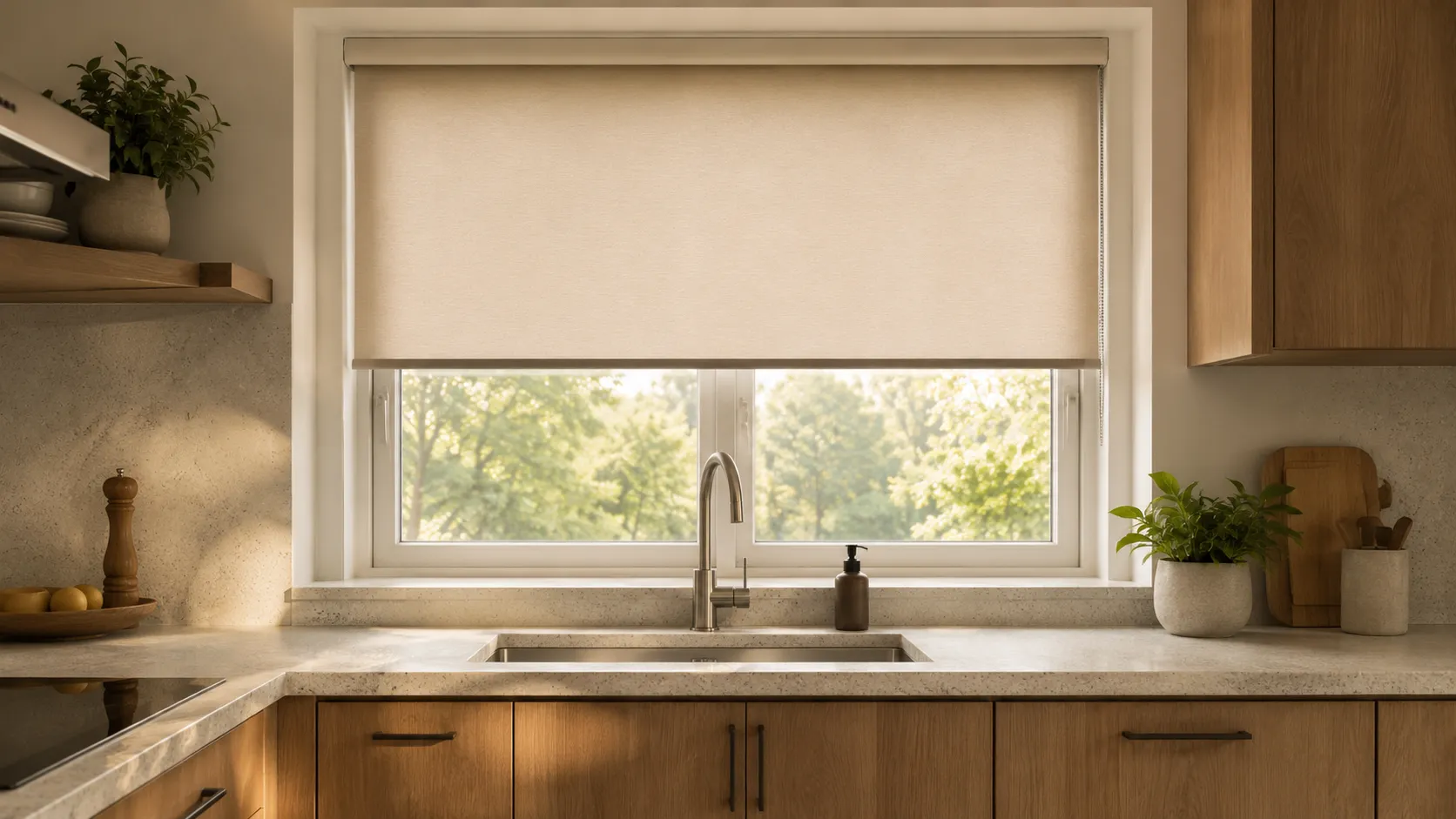
A leather sectional facing south in a Nepean living room can visibly yellow within two summers if the window in front of it goes uncovered during the afternoon. The glass looks like it should be doing something about that — it’s a barrier, after all — but most homeowners have never actually checked how much ultraviolet radiation their windows let through, or how much a closed blind changes that number. So do blinds block UV rays, or is that assumption doing more work than the fabric behind it actually does? The honest answer depends heavily on which product, which fabric, and how far it’s closed.
So, Do Blinds Block UV Rays? The Short Answer
Closed and opaque, most custom blinds block close to all of the UV radiation reaching that window — often in the high 90s as a percentage, the same physics that let them block visible light. Open a sheer band on a zebra blind or switch to a high-openness solar screen, though, and that number drops fast, sometimes to under 85%. The product family matters less than how tightly woven the fabric is and how much of the window it actually covers at any given moment.
How Much UV Gets Through Ordinary Window Glass
Glass isn’t the UV barrier most people assume it is. The Canadian Conservation Institute, part of the federal government’s own heritage-preservation arm, measured that standard untreated window glass blocks only about 26% of UV radiation on average — meaning roughly three-quarters of the UV hitting a typical pane still gets into the room. For comparison, the same testing found that dedicated UV-filtering acrylic panels cut UV by 95% or more, and conservation-grade films reach 99%. A newer double-pane window with a low-E coating cuts down more heat and glare than an older single-pane one, but that’s a different job than UV filtering, and neither does the work a closed shade does.
The same research notes something worth sitting with: both UV and visible light cause fading, not UV alone. Highly light-sensitive dyes and pigments — the kind used in a lot of upholstery and artwork — fade mainly from visible light exposure, while less-sensitive materials are affected more by the UV component. That’s why a UV-filtering window film alone, which does nothing to reduce visible light, only solves part of the problem. A blind that’s actually closed cuts both at once.
What That UV Actually Damages
On furniture, flooring, and art, ongoing UV exposure shows up as brittleness, cracking, or a chalky surface texture on the affected material, according to the same Canadian Conservation Institute research — the kind of gradual wear that’s easy to miss day to day until a cushion or armrest looks noticeably different from the fabric underneath it. Rugs and hardwood floors near a bright window fade unevenly for the same reason, tracing the exact shape of the sunlit patch on the floor.
On skin, the trend is harder to ignore. Dr. Jennifer Beecker, national chair of the Canadian Dermatology Association’s Sun Awareness Program, has pointed out that melanoma diagnoses in North America have climbed from roughly 1 in 1,500 people in the 1930s to close to 1 in 50 today, a shift she attributes largely to cumulative UV exposure over a lifetime — including the kind that happens indoors, near a bright window, without anyone thinking of it as “sun time.” A window seat that gets used daily for reading or working adds up over years in a way a single afternoon at the beach doesn’t.
How Much UV Do Blinds Block, by Fabric Type
Roller and solar screen fabrics are usually described by their openness factor — the percentage of the weave that’s literally open space rather than fibre. That number tracks closely with how much UV passes through:
| Fabric Openness | Approximate UV Blocked | Best Suited For |
|---|---|---|
| 1% openness | ~99% | Fading-prone rooms, art, west-facing furniture |
| 3% openness | ~92–96% | Home offices, screens, daytime glare control |
| 5% openness | ~88–92% | Balance of view and protection |
| 10% openness | ~80–85% | Maximum outside view, lighter protection |
| Opaque blackout (fully closed) | ~99%+ | Nurseries, media rooms, direct sun exposure |
A sheer or light-filtering fabric sits at the loose end of this range, sometimes well past 10% openness, which is why a gauzy curtain or a fully open zebra band does comparatively little against UV even though the room looks noticeably dimmer. The fabric has to be dense enough to block visible light before it’s doing serious UV work — the two aren’t separate settings on the same product.
Blinds vs. UV Window Film: Which Actually Helps More?
UV window film comes up often as an alternative, usually pitched as a set-and-forget fix applied straight to the glass. It’s worth comparing the two directly rather than assuming one replaces the other, because they solve overlapping but different problems.
| UV Window Film | Closed Opaque Blind | |
|---|---|---|
| UV blocked | Up to ~99% | ~99%+ |
| Visible light blocked | Minimal — most film is designed to stay clear | Nearly all, while closed |
| Heat and glare reduction | Some, depending on film type | Significant, especially with a light-blocking fabric |
| Privacy | None | Full, while closed |
| Adjustability | Fixed — same protection at every hour, whether needed or not | On demand — open for a view, closed during peak sun |
| Reversibility | Semi-permanent; removal can be difficult and may affect some window warranties | Fully reversible; no effect on the glass or its warranty |
Film has a real advantage for a window that never gets covered anyway — a stairwell skylight, for example — where there’s no blind to close in the first place. For a living room, bedroom, or home office, a blind covers more ground: it blocks the visible light that also drives fading, adds privacy and glare control the film can’t touch, and can be opened back up the moment direct sun moves off that wall.
A Worked Example: Two Rooms, Two Different Needs
A 4-by-5-foot west-facing window behind a home office desk in Kanata is a glare problem before it’s a UV problem — the person sitting there notices the screen washing out at 4 p.m. long before they’d notice fabric fading. A 3% openness roller solar screen in a mid-grey tone cuts an estimated 92–96% of the UV coming through that window while keeping enough of the outside view that the room doesn’t feel closed off, and it handles the glare on the monitor at the same time.
A south-facing nursery window of the same size is a different problem entirely: the goal there is closer to full blackout for daytime naps, and UV protection for a crib mattress and any nearby upholstered glider comes along as a side benefit rather than the main goal. An opaque blackout roller fabric, or a cellular blind in a room-darkening weave, blocks UV at close to the same rate as the office’s solar screen, but with none of the outside view retained — appropriate for a room where the view was never the point.
Matching the Product to the Room
A home office with a west-facing monitor is usually better served by a 1–3% openness roller blind in a solar screen fabric — glare and UV both drop sharply while the outside view stays legible enough to still feel like a window rather than a wall. A living room built around a leather sofa or an original piece of art wants the same low-openness approach, or a fully opaque fabric drawn during the hours the sun actually hits that wall.
Zebra blinds handle UV differently depending on band position: sliding the sheer sections into alignment lets in nearly as much UV as an uncovered window, while overlapping the solid bands cuts it close to what an opaque roller blind achieves. That range is the whole appeal of the product for rooms where light needs change through the day, but it also means UV protection on a zebra blind is only as good as how often the bands are actually closed. A cellular blind in an opaque fabric performs closer to blackout roller fabric on UV while adding the trapped-air insulation the honeycomb structure is built for — a reasonable pick for a nursery or bedroom that also runs cold in winter.
When UV Protection Matters Most
The Government of Canada rates UV exposure on a five-level index, and the same scale applies whether someone is standing outside or sitting a metre from an unshaded window:
| UV Index | Category |
|---|---|
| 0–2 | Low |
| 3–5 | Moderate |
| 6–7 | High |
| 8–10 | Very High |
| 11+ | Extreme |
Ottawa summers routinely push into the High to Very High range through midday in June, July and August, and Moderate readings are common well into September on a clear afternoon. UV doesn’t track with outdoor temperature the way heat does, so a cool, overcast-feeling room can still be taking meaningful UV exposure through an uncovered south or west window — the Government of Canada’s own guidance treats the index as a year-round factor, not a summer-only warning.
Protecting What’s in the Room, Not Just Who’s in It
Closing sun-facing blinds during the two or three hours a room gets direct light does more for fading prevention than leaving them half-open all day for a slightly brighter room. Rotating rugs, cushions, and any movable furniture every few months evens out fading that would otherwise trace a permanent sun-shaped patch into one side of a piece. None of that works if the window is the wrong size for the blind covering it — gaps at the edges of an ill-fitting blind let UV in around the fabric regardless of how dense the weave is, which is exactly why an accurate measurement matters as much as the fabric choice; our window shade measuring guide covers what to check before ordering.
Frequently Asked Questions
Do blinds block UV rays completely?
Not completely. Do blinds block UV rays entirely on their own? Only when closed and opaque — that gets a room close to 99% or more, similar to how it blocks most visible light. A sheer or open-weave fabric leaves a much bigger gap, sometimes only blocking 80–85% even at a moderate openness factor.
Which blocks more UV, roller blinds or zebra blinds?
A roller blind in an opaque or low-openness fabric blocks more UV consistently, since it’s a single flat sheet with one setting per position. A zebra blind can match that when its solid bands are fully overlapped, but drops back toward an uncovered window’s UV level whenever the sheer sections are aligned.
Does a sheer or light-filtering fabric block any UV?
Some, but not much compared to a denser weave. Sheer fabrics sit well above 10% openness in most cases, and UV blocking drops off quickly past that point — the fabric is doing more for glare and privacy than for UV at that density.
Can furniture still fade behind closed blinds?
Slowly, yes, particularly with highly light-sensitive fabrics or dyes that respond to visible light as much as UV. A closed, opaque blind slows fading dramatically compared with an uncovered window, but it isn’t a guarantee against any fading at all over years of daily use.
Is UV protection the same thing as heat or insulation?
No — they’re related but separate properties. A fabric can block UV well without doing much for heat transfer, and vice versa. Cellular blinds are the exception worth knowing about: their honeycomb structure adds real insulation on top of whatever UV protection the fabric itself provides.
How often should sun-facing blinds stay closed for UV protection?
During the two-to-three-hour window when direct sun actually reaches that room is usually enough for meaningful protection, rather than keeping blinds closed around the clock. A south or west room in Ottawa typically sees that direct exposure sometime between late morning and early evening, depending on the season.
Quick Summary
- Ordinary window glass blocks only about a quarter of incoming UV — a shade or blind is doing most of the real filtering work, not the window itself.
- Closed, opaque blinds block roughly 99% of UV; sheer fabrics and open zebra bands block far less, sometimes under 85%.
- Both UV and visible light drive fading, so a blind that’s actually closed protects furniture and flooring more completely than a UV-filtering film alone.
The right fabric and openness factor depend on the room, the furniture in it, and how much view matters to the people using it — a bay window with a fading leather chair needs a different answer than a home office chasing screen glare. Book a free in-home consultation to see fabric samples under your own windows, or request a quote for pricing on the right blind for a sun-exposed room. Questions before then? Contact Zenith Shade — French-language support is available for Montréal.