Official sources verified on October 17, 2026.
The best blinds for bay windows are usually three separate custom blinds, one fitted inside each window opening, so every section raises on its own and no two headrails meet at a corner. Roller blinds give the cleanest look on wide centre panes, zebra blinds handle daytime privacy on street-facing bays, and cellular blinds are the warmest choice for a cold Canadian bay. If the frames are too shallow for an inside mount, the blinds move outside the frame, and each headrail then has to stop short of the corner by a set amount (about 0.8 in for a 30° bay, 1.2 in for a 45° bay and 3 in for a box bay, with a 3-inch-deep headrail).
Those corner numbers are where most bay window orders go wrong, so they get their own section below. The rest of the decision comes down to the shape of your bay, how deep the frames are, and what the room is used for.
Try the fabric in all three windows before you order
Order up to 5 free fabric swatches from Zenith Shade, delivered anywhere in Canada in 3–5 business days. A bay catches light from three directions, so tape a swatch to the centre pane and one to a side pane and compare them at noon and late afternoon.
Covering a wide picture window or a wall of glass instead of a bay? See our guide to blinds for large windows, which covers size limits and when to split one window into several shades.
Bay Window Blinds at a Glance
A quick reference before the detail. Depths are typical exterior projections reported by window builders; your own bay can differ, so measure it.
| Window shape | Angle of side windows to centre | Typical projection | What usually works |
|---|---|---|---|
| 30° bay | 30° | 12 to 14 in | Three inside-mount blinds; outside mount is easy if needed because the corner setback is small |
| 45° bay | 45° | Deeper than a 30° bay | Three inside-mount blinds; an outside mount needs about 0.8 to 1.5 in of setback at each corner |
| Box bay | 90° | About 16 to 24 in | Three inside-mount blinds, or a centre blind plus two side blinds planned so they do not collide in the square corners |
| Bow window | About 10° between units (Andersen bows) | Varies | One blind per window in most cases; check that narrow units still fit the chosen headrail |
The angles come from Andersen’s bay and bow window range. This Old House puts a typical 30° bay at 12 to 14 inches of projection, and Canadian window company Magic Window says most box bays project 16 to 24 inches from the exterior wall.
What Makes a Bay Window Different
A bay window is three or more windows joined into one unit that projects out from the wall. The common layout is a wide centre window, usually a picture window, with a narrower window on each side. Those side windows (the flankers) are usually casements or double-hung units, and they sit at 30°, 45° or 90° to the centre. A bow window is the curved cousin: four or more windows, each turned a few degrees so the whole unit forms an arc. Andersen builds its bows from casements set at 10° to each other.
Three things follow from that shape, and each one changes the blind order:
- Three openings, three sizes. The centre window can be twice the width of the flankers or more. One blind across the whole bay cannot follow the angles, so you are almost always ordering a set.
- Light from three directions. A south-facing bay gets east light on one flanker in the morning and west light on the other in the afternoon. A fabric that looks right on the centre pane at noon can look much brighter on a side pane at 4 p.m.
- Operable side windows. Casement flankers have crank handles on the sill, and double-hung flankers have locks at the meeting rail. Both can get in the way of a blind’s bottom rail.
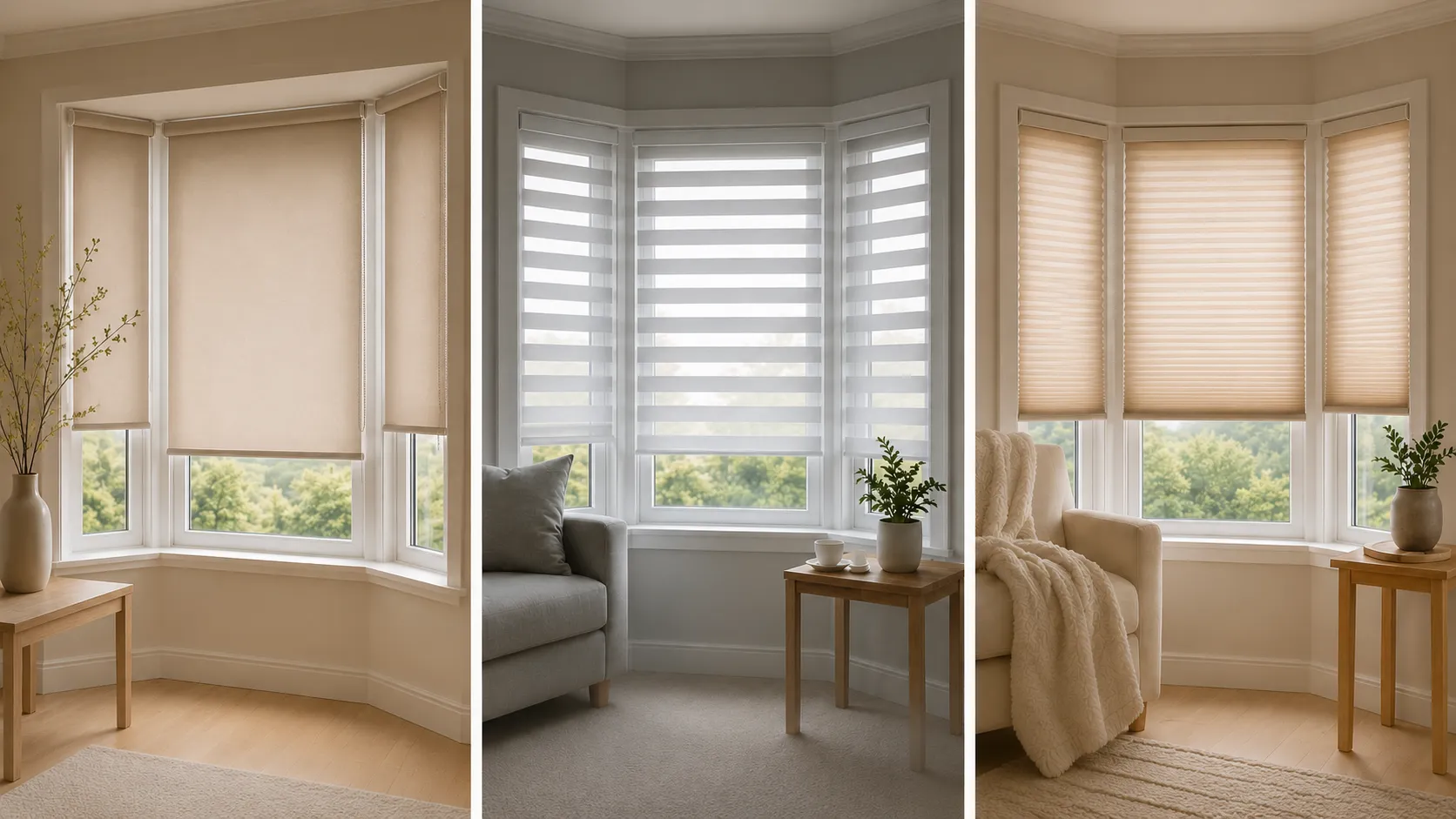
Best Blinds for Bay Windows: Roller, Zebra and Cellular Compared
Zenith Shade makes three blind styles, all to measure and all available with inside or outside mount: roller blinds, zebra blinds and cellular blinds. Each one suits a different kind of bay. The hardware depths below are the planning figures from our window shade measuring guide; the exact depth is confirmed when the system is chosen.
| Blind | Approx. hardware depth | Light control | Best bay situation |
|---|---|---|---|
| Roller, open roll | About 3 in | Light filtering or room darkening | Wide centre panes, minimal look, shallow-ish frames |
| Roller, compact cassette | About 3 1/2 in | Light filtering or room darkening | Bays where the roll would be visible from the street |
| Roller, fascia | About 3 1/2 to 4 3/8 in | Light filtering or room darkening | Outside-mount bays where the tops should read as one line |
| Zebra, cassette | Confirm before order | Light filtering with adjustable privacy bands | Living-room bays facing a street or neighbour |
| Cellular headrail | About 2 to 2 1/2 in | Light filtering or room darkening | Cold bays, bedroom bays, frames with limited depth |
Roller blinds for bay windows
Roller blinds for bay windows work best when you want the glass to read as three clean planes. The fabric rolls tight to the top, so when the blinds are up you see almost all of the window. Room-darkening fabric is available, which matters in a bedroom bay. The trade-off is depth: an open roll needs about 3 inches of flat surface, and a cassette needs a little more. On a 45° bay with thin frames, that is the first thing to check.
Zebra blinds for bay windows
Zebra blinds layer sheer and solid bands, and sliding the bands past each other moves you from soft daylight to privacy without raising anything. That is useful in a front-room bay that faces the sidewalk, because a bay pushes the glass closer to the street than the rest of the wall. Zebra blinds are a light-filtering product. If the bay is in a bedroom and you need it dark, a room-darkening roller or cellular blind is the better fit. Our zebra vs roller comparison covers the privacy difference in more detail.
Cellular blinds for bay windows
Cellular blinds have the shallowest headrail of the three, at about 2 to 2 1/2 inches, so they are often the answer when a bay’s frames are too shallow for a roller cassette. The honeycomb cells trap air against the glass, which is why they are the usual pick for a bay that feels cold in January. More on the energy side further down.
What Zenith Shade does not make
Other retailers sell wood and faux-wood blinds, vertical blinds, shutters and Roman shades for bays, and some sell a panel-track system built for the bay angle. We do not make those, so if one of them is what you want, a roller, zebra or cellular blind will not be a like-for-like substitute. For most bays, three fabric blinds do the job with less hardware at the corners.
Inside Mount or Outside Mount on a Bay Window
Start with an inside mount. Each blind sits inside its own window frame, the angled walls between the windows stay visible, and the headrails never get near each other. An inside mount needs enough flat depth inside each frame for the headrail and brackets, which is where the hardware table above comes in. Measure depth at every window, not just the centre one: flankers are sometimes shallower than the picture window.
An outside mount makes sense when:
- the frames are too shallow for the chosen headrail, or the flat surface is broken by a sloped sill or trim;
- casement cranks or double-hung locks would hit the bottom rail of an inside-mount blind;
- you want to block more light at the edges, for example in a bedroom bay, since overlap around the opening reduces side light gaps.
Outside mount on a bay brings its own problem at the corners, covered next. Our inside mount vs outside mount guide goes through the general trade-offs if you are still deciding.
The Corner Problem: How Much Room Headrails Need
When blinds are mounted on the wall or ceiling around a bay instead of inside each frame, two headrails approach every corner from different directions. Because each headrail sticks out from its mounting surface, their front edges meet before their back edges do. If each blind runs right into the corner, the headrails hit each other and at least one blind will not fit.
The fix is to stop each headrail short of the corner. The amount depends on the headrail depth and the bay angle, and it is plain geometry: setback = headrail depth × tan(half the angle between the two windows). With that setback on both sides, the front corners just touch; add a small working gap on top so the fabric can roll freely.
| Headrail depth | 30° bay (each side) | 45° bay (each side) | Box bay, 90° (each side) | Bow, 10° joints (each side) |
|---|---|---|---|---|
| 2 in (slim cellular) | 0.54 in | 0.83 in | 2.0 in | 0.17 in |
| 2 1/2 in (cellular) | 0.67 in | 1.04 in | 2.5 in | 0.22 in |
| 3 in (open roll) | 0.80 in | 1.24 in | 3.0 in | 0.26 in |
| 3 1/2 in (cassette) | 0.94 in | 1.45 in | 3.5 in | 0.31 in |
A worked example. A 45° bay with an outside mount on the wall above the windows and a 3 1/2-inch roller cassette: each headrail stops about 1.45 inches from the corner, so the two blinds at that corner give up roughly 2.9 inches of combined width before any working gap. In a box bay with the same cassette, each headrail stops 3.5 inches from the corner. That is why box bays are so often done inside mount.
Two practical points. First, the setback reduces fabric coverage at the corner, so an outside-mount bay will show a thin strip of light at each joint unless the fabric overlaps the frame there. Second, use the table to check whether an outside mount is workable at all. The final widths depend on the exact hardware, the bracket type and how square your bay is, which is why we review bay measurements before an order goes to production.
One Blind per Window, or Fewer?
For a standard three-window bay, one blind per window is nearly always right. It lets you open a flanker for air while the centre stays down, keep morning sun off one side without darkening the room, and replace or adjust one blind later without touching the others.
There are two cases where fewer blinds come up. A very shallow 30° bay with thin mullions can sometimes be read as one wide surface, but the blind still cannot bend around the angle, so you would still order three. A bow window with five or six narrow units is the other: each unit is narrow, so we check every window width against the size limits of the chosen headrail and motor before recommending a layout.
Bay Windows in a Canadian Winter: Heat Loss and Condensation
A bay has more glass than a flat window of the same width, and it sticks out into the cold on three sides. Natural Resources Canada’s Keeping the Heat In guide says windows, doors and skylights can account for up to 35% of a house’s total heat loss, and that curtains and blinds can help reduce radiant heat loss from windows in the heating season.
Cellular blinds have the strongest evidence. The U.S. Department of Energy’s fact sheet Interior Cellular Shades Boost Home Energy Performance (DOE/EE-2519, October 2021) reports that cellular shades saved up to 20% on heating energy and up to 15% on total heating and cooling energy compared with no shades at all. Those figures come from a modelled single-family home built on test-house measurements in Tennessee, so read them as an upper bound for a Canadian bay.
The same NRCan page adds a caution that matters more in a bay than almost anywhere else: curtains and blinds are not airtight, and they can cause window condensation problems in winter. A blind traps a layer of air against cold glass, and moist room air that leaks behind it can condense on the pane. In practice:
- raise the bay blinds for part of the day in cold weather so the glass can warm and dry;
- leave a little space between the bottom rail and any window-seat cushion so air can move;
- if water pools on the sill every morning, look at indoor humidity before blaming the blind.
Our guide to blinds and window condensation covers the humidity side, including what indoor humidity does to cold glass.
Cordless and Motorized Control Across a Bay
A bay means three or more blinds within arm’s reach of a window seat, which is exactly where children climb. Canada’s Corded Window Coverings Regulations (SOR/2019-97) limit any reachable cord to 22 cm and any loop to a 44 cm perimeter when pulled with a force of 35 N. The rules came into force on May 1, 2021. In its 2019 announcement, Health Canada said it was aware of 39 deaths in Canada linked to corded window coverings since 1989.
Zenith Shade roller, zebra and cellular blinds are all available with cordless options (where suitable for the window) and with motorized control. On a bay, motorization is worth a look for two reasons. Reaching across a deep window seat or a sink to the centre blind gets old quickly, and grouped control lets one remote or schedule move all three blinds together, or just one side. See our motorized blinds options and the cordless blinds safety guide for the rules in full.
Window Seats, Radiators and Furniture in the Bay
Bays often hold a built-in seat, a radiator or a sofa pushed into the recess. Each one changes where the blind should stop.
- Window seat. Measure inside-mount height down to the top of the seat board, not the cushion. Window builder Magic Window suggests at least 18 inches of interior depth for a usable seat, so in a box bay the seat and the blinds share a fairly tight space.
- Radiator or baseboard heater under the bay. Keep the blind inside the frame so warm air can rise past it into the room.
- Casement cranks. If a crank sits on the sill, an inside-mount bottom rail can land on it. A reverse roll, a projection bracket or an outside mount usually solves it.
Measuring for Blinds for Bay Windows: A Checklist
The full method is in the measuring guide linked above. For a bay, these are the steps that matter most:
- Treat each window as its own opening and number them left to right.
- Measure each inside width at the top, middle and bottom, to the nearest 1/16 inch, and record the narrowest.
- Measure each height at the left, centre and right and note the smallest usable height.
- Measure the flat depth inside each frame and compare it with the hardware depth table above.
- Note cranks, locks, handles, seat boards and heaters at each window.
- If you are planning an outside mount, measure the bay angle or tell us the bay type, and photograph each corner.
- Send the numbers and photos with your quote request so we can check the corners before production.
Common Mistakes With Bay Window Blinds
- Ordering all three blinds at the centre window’s depth when the flankers are shallower.
- Running outside-mount headrails into the corners with no setback, so the last blind will not fit.
- Choosing one fabric from a swatch held only at the centre pane, then finding the side panes look brighter or warmer in the afternoon.
- Forgetting the casement crank, so the bottom rail rests on it.
- Picking a light-filtering zebra blind for a bedroom bay and expecting it to darken the room.
How to Order Bay Window Blinds From Zenith Shade
- Order up to 5 free fabric swatches and check them on the centre and side panes at different times of day.
- Decide inside or outside mount for each window, using the depth table.
- Measure every window with the checklist above.
- Send measurements and photos through our quote request form, or book an in-home consultation if you live in the Ottawa area. French-language support is available for customers in Montréal.
Every order is backed by our Perfect Fit Guarantee. Browse the full custom blinds range to compare the three styles side by side.
Frequently Asked Questions
What are the best blinds for bay windows?
For most homes, the best blinds for bay windows are three custom blinds, one inside each window frame. Roller blinds suit a clean look, zebra blinds suit privacy on a street-facing bay, and cellular blinds suit cold or bedroom bays.
Should bay window blinds be inside or outside mount?
Inside mount is usually better, because each blind sits in its own frame and the headrails never collide at the corners. Choose outside mount only when the frames are too shallow or a crank or lock gets in the way.
Can you put one blind across a whole bay window?
No. A single blind cannot follow the angle between the windows, so a three-window bay needs at least three blinds. A bow window usually needs one blind per window too.
How much gap do you leave between blinds at a bay window corner?
For an outside mount, each headrail should stop short of the corner by its depth times the tangent of half the bay angle. With a 3-inch headrail that is about 0.8 inch on a 30° bay, 1.2 inches on a 45° bay and 3 inches on a box bay, plus a small working gap.
Are cellular blinds good for bay windows?
Yes. They have the slimmest headrail of the three Zenith Shade styles, at about 2 to 2 1/2 inches, and a U.S. Department of Energy fact sheet reports heating savings of up to 20% versus no shades in its modelled home.
Do bay window blinds cause condensation?
They can. Natural Resources Canada notes that blinds are not airtight and may cause window condensation in winter, so raise them for part of the day and keep indoor humidity in check.
Can bay window blinds be motorized?
Yes. Roller, zebra and cellular blinds can all be motorized, and grouped control lets you move all the blinds in the bay together or one at a time.
The Short Version
Order one blind per window, inside mount if the frames are deep enough, and pick the fabric by looking at swatches on more than one pane. If the blinds have to go outside the frames, plan the corner setbacks before you order. Cellular blinds are the warm option for a cold bay, rollers the clean one, and zebras the privacy one.