Official sources verified on October 23, 2026.
In the blinds vs curtains decision, blinds win on precise fit, small footprint, easy cleaning and cord-safe operation, while curtains win on softness, sound absorption and the ability to cover a whole wall of glass with one treatment. For winter heat, neither category wins by default: ordinary curtains cut window heat loss by up to about 10%, and a tightly fitted shade or a lined curtain sealed at the edges does roughly two to four times as much. Most Canadian homes end up with blinds on working windows (kitchens, bathrooms, kids’ rooms, windows behind furniture) and curtains, or both layered together, in living rooms and bedrooms.
This guide compares the two for typical Canadian houses and condos as of October 2026. Zenith Shade is an Ottawa-based maker of custom roller, zebra and cellular blinds, manual or motorized. We do not sell curtains or drapery, so we have kept the curtain side of this comparison to what independent and government sources say and to what we see on real windows. Where curtains are the better answer, we say so.
Blinds vs Curtains at a Glance
| Factor | Blinds (roller, zebra, cellular) | Curtains and drapes | Edge goes to |
|---|---|---|---|
| Light control | Fabric choice sets the level, from sheer to room darkening; small gaps at the sides of an inside mount | Lined or blackout fabric blocks a lot of light, but light leaks at the top, sides and centre unless panels overlap | Tie: depends on fit and fabric |
| Winter heat loss | Close-fitting inside-mount shades and cellular shades perform well | Conventionally hung curtains: up to about 10% less window heat loss; sealed and lined: more | Blinds, unless curtains are lined and sealed |
| Space used | Sits inside the frame or just above it; stacks in a few inches | Panels stack beside the window and need wall space and a rod | Blinds |
| Furniture, sinks, heaters | Clears beds, counters and baseboard heaters | Fabric can drape over or be blocked by them | Blinds |
| Cleaning | Vacuum or wipe in place; flat fabrics are easiest | Need taking down for washing or dry cleaning | Blinds |
| Child safety | Cordless and motorized options remove reachable cords | No cords on a plain rod; corded traverse rods fall under the same rules as blinds | Tie when both are cordless |
| Sound and softness | Single fabric layer, little sound absorption | Heavy fabric softens echo in rooms with hard floors | Curtains |
| Very wide or floor-to-ceiling glass | May need several panels or motorization | One rod can run the full width | Curtains, or blinds plus curtains |
Light Control: Blinds Fit Tighter, Curtains Need Overlap
Blinds give you finer control because the fabric sits close to the glass and moves as one flat panel. On a roller blind the fabric itself decides how much light gets through, from see-through screen weaves to room-darkening fabrics. Zebra blinds alternate sheer and solid bands, so you can let in filtered daylight without fully opening the blind. Cellular blinds come in light-filtering and room-darkening versions, and the honeycomb gives a soft, even glow.
The weak spot of a blind is the edge. An inside-mounted blind has to clear the frame, so a thin line of light shows at each side. Our own roller blind page is clear that room-darkening fabric blocks much more light but is not a full 100% blackout, and the zebra blind page describes zebras as light filtering, not blackout. For a bedroom that must be dark at 5 a.m. in June, mount the blind outside the frame with overlap, or add a curtain over it. Our guide to room darkening vs blackout blinds walks through those options.
Curtains block light well across their face, especially with a blackout lining, but light escapes over the rod, around the sides and down the middle where two panels meet. A curtain that stops short of the floor or sits close to the frame leaks the most. Wider rods, panels that overlap in the centre and a top cover such as a cornice or valance all reduce leaks.
Winter Heat Loss: Fit Matters More Than the Category
Natural Resources Canada estimates that windows, doors and skylights can account for up to 35 percent of a house’s total heat loss, and notes that curtains and blinds can reduce radiant heat loss in winter and solar gain in summer. The same NRCan Keeping the Heat In guide (section 8) says insulated drapes offer somewhat more benefit than non-insulated drapes and blinds, which is a useful reminder that a heavy, lined curtain can outperform a thin blind.
How the treatment is installed matters as much as what it is. A U.S. Department of Energy Energy Saver bulletin puts tightly installed cellular shades at about 40% less heat loss through windows, against up to 10% for most average draperies. A Cornell Cooperative Extension housing fact sheet on energy-saving window treatments gives a fuller ranking:
| Window treatment (Cornell fact sheet) | Reduction in window heat loss |
|---|---|
| Drapery, conventionally hung on a traverse rod | 5–10% |
| Standard venetian (slatted) blind | 6–7% |
| Roller shade, inside mount, no more than 1/4 in gap at the sides | 24–31% |
| Drapery, tightly woven, separate lining, sealed at all four edges | 25% |
| Roller shade with side tracks and/or 1 in from the glass, inside mount | 40–45% |
Two practical points follow. First, a curtain hung a few inches off the wall with an open top lets warm room air flow down behind it, cool against the glass and spill out at the floor; Cornell calls this the “tunnel” effect and recommends closing the top with a cornice. Second, a blind that fits the frame closely and sits near the glass traps a still layer of air between the fabric and the glass, and that air layer is what slows the heat loss. If insulation is your main reason for buying, cellular blinds are the strongest option we make; our article on energy efficient blinds in Canada covers what to expect from them and whether any rebate applies.
Condensation on Cold Canadian Glass
Any window covering that traps room air away from cold glass can raise condensation. NRCan states plainly that because curtains and blinds are not airtight, they may cause window condensation problems in winter. Heavy curtains closed all night over a single-pane or older double-pane window are a common culprit, because they hold the glass colder for longer and keep moist air against it.
The fix is the same for both: open the covering for part of the day, keep indoor humidity under control and leave a little air movement at the bottom of the window. Blinds have a small advantage because they lift clear of the glass completely and do not bunch against the sill. Our guide to whether blinds cause window condensation covers humidity settings and a step-by-step routine for Canadian winters.
Privacy and Day-to-Night Use
Privacy depends on the fabric and on whether you can see in when the lights are on. Sheer curtains and light-filtering blinds both give daytime privacy and then become see-through at night when the room is brighter than outside. To get privacy after dark you need an opaque layer: a room-darkening blind, a lined curtain, or a sheer and a solid layer used together.
Blinds handle the day-to-night switch in one product. A zebra blind moves from filtered daylight to a solid face with a short pull, and a top-mounted roller can be lowered just far enough to cover the lower half of a street-facing window. Curtains usually need two layers (a sheer and a lined panel on a double rod) to do the same job.
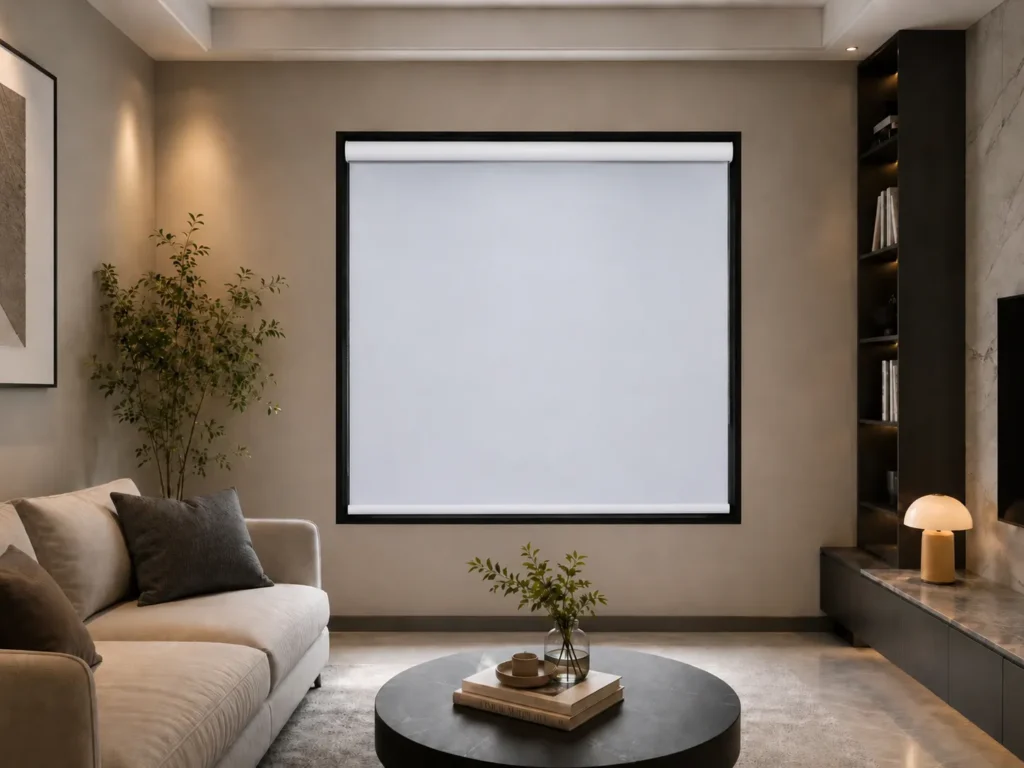
Cleaning, Dust and Allergies
Blinds are easier to keep clean. Flat roller fabrics can be vacuumed with a brush attachment and spot-cleaned in place, and cellular and zebra fabrics need only a little more care. Curtains collect dust across a large surface and usually have to come down for washing or dry cleaning. Our guide to cleaning roller, zebra and cellular blinds has the routines.
For people with dust allergies, MedlinePlus (the U.S. National Library of Medicine’s health information service) advises replacing slatted blinds and cloth draperies with pull-down shades because they will not collect as much dust. Roller blinds are pull-down shades in that sense, which makes them a sensible pick for a bedroom where someone has dust allergies. If you prefer curtains, choose machine-washable fabric and plan to wash it regularly.
Child Safety and Cords
Canada’s Corded Window Coverings Regulations (SOR/2019-97) have applied since May 1, 2021. They define a corded window covering as any indoor window covering equipped with at least one cord, and the definition of “cord” includes chains. A reachable cord with one free end must not exceed 22 cm when pulled with a force of 35 N, and any loop must not exceed 44 cm in perimeter.
That definition covers both categories. A curtain on a plain rod or track with no cords is outside the rules because it has no cord, but a curtain on a cord-drawn traverse rod is a corded window covering just like a corded blind. In a nursery or child’s bedroom, the safest choices are cordless or motorized blinds, or curtains on a rod with no cords, kept short enough that they do not pool where a toddler can pull on them. Our cordless blinds safety guide explains the rules in more detail.
Space, Furniture and Awkward Windows
This is where blinds have the clearest advantage. A blind sits inside the frame or just above it and lifts into a compact roll or stack. Curtains need wall space on each side for the panels to stack back, plus room for the rod brackets above the window, and the fabric hangs over anything in front of the glass.
- Kitchen sinks and counters. Curtains above a sink get splashed and touch the tap. A wipeable roller blind is the usual answer; see our kitchen and bathroom blinds guide.
- Beds, desks and sofas against the window. Curtains bunch on the furniture. A blind clears it.
- Baseboard heaters under the window. Long curtains cover the heater and block warm air from rising past the glass. A blind that stops at the sill leaves the heater open.
- Sliding patio doors. Both can work; curtains on a wide rod stack clear of the opening, while blinds need careful planning around handles. Our sliding glass door guide compares the options.
- Floor-to-ceiling and very wide glass. One long curtain track can cover a whole wall. Blinds may need several panels or a motor; see blinds for large windows.
- Rentals and condos. Check what your lease or building allows before drilling; our condo window covering rules article covers common restrictions.
Cost: What You Pay For With Each
Prices vary too much by size, fabric and hardware for a single number to be useful, so compare what each quote includes. With blinds, a custom price usually covers the fabric, the roller or headrail, the control (chain, cordless or motor) and a cassette or valance if you choose one. With curtains, the panels are only part of the cost: you also pay for the rod or track, brackets, rings or hooks, any lining, and hemming if ready-made lengths do not fit.
Curtains need more fabric than the window is wide, because panels are gathered rather than stretched flat, and that extra width is a large part of the cost of custom drapery. Blinds use only as much fabric as the window, so on a window of the same size, the fabric share of a blind is smaller. Motorization adds cost to either. For an exact figure on your windows, request a free quote.
Room-by-Room: Blinds or Curtains?
Most blinds vs curtains questions are really about one room at a time, because a kitchen and a bedroom ask for different things from the same window.
| Room | Usual best choice | Why |
|---|---|---|
| Living room | Blinds, with curtains optional for softness | Blinds handle glare on screens; curtains add warmth and soften echo |
| Primary bedroom | Room-darkening blind, often layered with curtains | The blind controls light at the glass; curtains cover edge leaks |
| Nursery and kids’ rooms | Cordless or motorized blinds | No reachable cords; nothing to pull down |
| Kitchen | Wipeable roller blind | No fabric near the sink or stove |
| Bathroom | Moisture-resistant roller blind | Curtains absorb humidity and need frequent washing |
| Home office | Light-filtering roller or zebra blind | Cuts screen glare and keeps daylight |
| Basement | Cellular or roller blind | Shallow frames and limited wall space; see our basement window guide |
| Patio door | Either; blinds for a clean look, curtains for full-width stacking | Depends on handle clearance and wall space |
Using Blinds and Curtains Together
Layering gives you most of the strengths of both. The blind does the work at the glass (light control, privacy, a tight fit and a closer air layer for winter), and the curtain adds softness, sound absorption and cover for the light gaps at the edges. It also lets you choose a lighter blind, since the curtain handles the last bit of darkness.
Worked example: a 48 inch bedroom window
Say the window opening is 48 inches wide and the frame has enough depth for an inside mount. You want the room dark for sleep and soft-looking in the daytime.
- Fit a room-darkening roller blind inside the frame, measured to the nearest 1/16 inch as our measuring guide recommends. It sits close to the glass and leaves the trim visible.
- If you would rather mount the blind outside the frame, the measuring guide suggests 1.5 to 3 inches of overlap on each side, which makes the blind 51 to 54 inches wide on a 48 inch opening.
- Hang a curtain rod above the trim and wide enough that the open panels stack on the wall beside the window, not over the glass. Closed, the panels should overlap in the centre to cover the light lines at the sides of the blind.
- In winter, open both layers on sunny days and leave the bottom of the curtain clear of the sill at night so the glass does not collect condensation.
Check the depth before you order. The measuring guide lists about 3 inches of flat depth for an open roll and about 3 1/2 inches for a compact cassette, so a shallow frame may push you to an outside mount. Our inside mount vs outside mount guide covers that choice.
Comparing fabrics for blinds, curtains or both?
Request free fabric samples from Zenith Shade and hold them against the window at midday and again at night with the lights on. If you plan to layer a curtain, bring the curtain fabric too, so you can see the colours together in your own light.
Common Mistakes When Choosing Between Blinds and Curtains
- Buying blackout curtains for a bedroom and hanging them on a short rod close to the frame, so light pours in at both sides.
- Expecting thin curtains to cut heating costs. Conventionally hung drapery reduces window heat loss by only about 5–10%.
- Closing heavy curtains over cold glass all night and every day, then wondering why the sill is wet.
- Putting long curtains over a baseboard heater or a kitchen counter.
- Choosing a corded traverse rod or corded blind for a child’s room when cordless options exist.
- Measuring for an inside-mount blind without checking frame depth and handle clearance.
- Ordering every window in the house the same way. Blinds suit some rooms and curtains suit others.
Checklist Before You Decide
- What does the room need most: darkness, privacy, insulation, softness or easy cleaning?
- Is there furniture, a sink, a heater or a door handle in front of or below the window?
- How much wall space is there beside the window for curtain panels to stack?
- How deep is the frame, and will the blind be inside or outside mount?
- Will children use the room? If so, cordless or motorized only.
- Do you want one layer, or a blind plus curtains?
- Have you seen the fabric samples in your own light, day and night?
Frequently Asked Questions
Blinds vs curtains: which is better?
Neither is better everywhere. Blinds are better for kitchens, bathrooms, kids’ rooms and windows behind furniture, while curtains are better for softening large living spaces and covering full walls of glass.
Are blinds or curtains better for keeping heat in?
A well-fitted shade usually beats ordinary curtains. The U.S. Department of Energy puts tightly installed cellular shades at about 40% less window heat loss and most average draperies at up to 10%; a lined curtain sealed at the edges does better than a loose one.
Are blinds or curtains better for a bedroom?
A room-darkening blind is the better base layer because it controls light at the glass. Add curtains if you want a darker room, softer look or less echo; the curtain covers the light gaps at the blind’s edges.
Do curtains make a room darker than blinds?
Only if they overlap the window generously. Blackout curtains block a lot of light across their face, but light leaks over the rod and at the sides; a blind mounted outside the frame or layered under a curtain gives the darkest result.
Can you use blinds and curtains together?
Yes. Mount the blind inside or just outside the frame and hang the curtain rod above and wider than the window so open panels stack on the wall.
Are curtains safer than blinds for children?
Not automatically. Canada’s Corded Window Coverings Regulations cover any indoor window covering with a cord, so a corded curtain rod and a corded blind fall under the same rules; cordless blinds, motorized blinds and curtains on a plain rod avoid reachable cords.
Are blinds or curtains better for allergies?
Smooth pull-down shades are usually better. MedlinePlus advises replacing slatted blinds and cloth draperies with pull-down shades because they collect less dust.
Summary
The blinds vs curtains choice comes down to the job each window has to do. Choose blinds where fit, cleaning, safety and space matter most, and curtains where you want softness and full-wall coverage. For heat, judge the installation rather than the category: a close-fitting shade or a lined, sealed curtain does far more than a loose one. In bedrooms and living rooms, a blind layered with curtains often gives the best of both. This guide reflects Canadian regulations and published sources as of October 2026; your own window measurements and building rules come first.
Ready to plan your windows? Request a free quote and fabric samples, or browse all custom blinds to compare fabrics.