Official sources verified on October 26, 2026
Light filtering blinds use a translucent fabric that lets daylight pass through as a soft, even glow while blocking the direct view and most of the harsh glare from the sun. They keep a room bright and give good daytime privacy, but they do not darken a room for sleep, and with lamps on at night people outside can see shapes behind them. Choose them for living rooms, kitchens and home offices; choose room-darkening fabric where you need the room dim.
The rest of this guide covers where light filtering sits between sheer and room-darkening fabric, why it matters more in a Canadian winter, what the research says about fabric colour, how each Zenith Shade product line handles it, and a simple way to test a sample at your own window.
Light filtering blinds at a glance
| Fabric type | What you see from inside | Daytime privacy | Night privacy, lights on | Darkness for sleep | Best rooms |
|---|---|---|---|---|---|
| Sheer or open-weave screen | A view out, dimmed | Low to partial | Low | None | Sunrooms, offices with a view you want to keep |
| Light filtering | Bright, diffused glow; no clear view | Good: shapes blurred | Partial: silhouettes show | Low | Living rooms, kitchens, dining rooms, home offices |
| Room darkening | Very little light through the fabric | Full | Full, apart from edge gaps | Good, not total | Bedrooms, media rooms, nurseries |
| Dual roller (light filtering + room darkening) | Your choice of either layer | Good to full | Full with the back layer down | Good with the back layer down | Bedrooms that also serve as daytime rooms, street-level rooms |
What “light filtering” actually means
Light filtering is a middle grade of fabric opacity: light goes through the material, but it scatters on the way, so you get brightness without a clear picture of what is outside. The fabric is woven or coated tightly enough that there are few open holes to look through, yet thin or pale enough that daylight still reaches the room.
It helps to picture a scale. At one end are sheers and open-weave screen fabrics, where the gaps between the threads are large enough to keep a view. At the other end are room-darkening and blackout materials, which stop almost all light passing through the fabric itself. Light filtering sits between them. Manufacturers do not use one shared numeric cut-off for the term, so two “light filtering” fabrics from different collections can feel quite different at the same window. That is why a sample at your own window tells you more than a label.
Two properties decide where a fabric lands on that scale. Openness is the share of the fabric that is open space between threads; we covered the common openness grades in our guide to whether blinds block UV rays. Colour and density decide how much of the light that hits the threads passes through or bounces back. A tightly woven ivory fabric and a tightly woven charcoal fabric can have the same openness and still look and behave very differently, which we come back to below.
Light filtering vs room darkening: the real difference
Light filtering fabric keeps a room usable without lamps; room-darkening fabric is made to make the room dim. On our roller blinds page we put it this way: light filtering softens daylight while keeping the room bright, while room-darkening fabric blocks significantly more light for sleep, media or focus, though it is not a full 100% blackout.
In practice, the choice comes down to what the room is for at its busiest time of day:
- If people use the room mostly in daylight and want it bright, light filtering is usually right.
- If someone sleeps there, works night shifts, or watches a projector or large TV during the day, room darkening is the safer choice.
- If the room has to do both, a two-layer setup handles it better than any single fabric.
If darkness is the main goal, our comparison of room darkening vs blackout blinds goes further into edge gaps and early-morning light.
Why light filtering blinds matter more in a Canadian winter
Low winter sun reaches far deeper into a room, so glare from south-facing windows is worst in the months when you most want the daylight. At Ottawa’s latitude (about 45.4° N), the noon sun on December 21 is only about 21° above the horizon. In late June it is about 68° up. A light filtering blind lets you keep that low winter light without having it land directly on a screen, a sofa or your eyes.
We worked out how far direct noon sunlight reaches across the floor through a south-facing window whose top edge sits 2.1 m (about 6 ft 11 in) above the floor. These are simple geometry figures for solar noon, rounded, and they ignore roof overhangs, trees and neighbouring buildings:
| Date (Ottawa, solar noon) | Sun height above horizon | How far direct sun reaches into the room |
|---|---|---|
| December 21 | About 21° | About 5.4 m (17 ft 10 in) |
| March 20 / September 22 | About 45° | About 2.1 m (7 ft) |
| June 21 | About 68° | About 0.85 m (2 ft 9 in) |
In winter, a beam of sun can cross most of a typical living room. That is where light filtering blinds earn their keep: lowered on a bright January afternoon, they turn a hard patch of sun into an even glow across the whole room.
There is a heating side to this too. Natural Resources Canada notes that windows, doors and skylights can account for up to 35 percent of a house’s total heat loss, and that curtains and blinds can help reduce radiant heat loss from windows during the heating season and reduce solar gain in summer (NRCan, Keeping the Heat In, section 8). The same page warns that blinds are not airtight and can contribute to window condensation in winter. A light filtering blind is a glare tool first; for insulation, see our guide to thermal blinds and condensation behind blinds.
Glare, screens and home offices
For a desk near a window, light filtering blinds work best combined with the right desk position. The Canadian Centre for Occupational Health and Safety (CCOHS) lists sunlight as a source of direct glare and recommends positioning a workstation so that windows are parallel to the worker’s line of sight, not in front of or behind the screen (CCOHS, Lighting Ergonomics: Survey and Solutions). Its office lighting checklist includes blinds or curtains on windows as a basic control (CCOHS checklist).
The numbers explain why. CCOHS gives 500 to 1,000 lux as usually adequate general lighting, and 75 to 300 lux for computer tasks, depending on the screen. The Canadian Conservation Institute’s light guidance uses about 5,000 lux as a reference level for a window and 30,000 lux for average daylight outdoors (CCI, Agent of Deterioration: Light, Ultraviolet and Infrared). A bright window beside a monitor can therefore be many times brighter than the screen you are trying to read. A light filtering fabric lowers that contrast without making you switch on the overhead light at 2 p.m.
Worked example: a south-facing home office in Ottawa
Say your desk faces a 48 in wide south window and your monitor sits with its back to the glass. In December, the low noon sun shines straight past the monitor into your eyes, and the screen looks dim against the bright window behind it.
- Move the desk first. Turn it 90° so the window is on your left or right, as CCOHS suggests. That one change removes the bright background behind the screen.
- Add a light filtering roller blind. Mounted outside the frame with the overlap our measuring guide recommends (1.5 to 3 in on each side), a 48 in opening would take a blind roughly 51 to 54 in wide, which also trims the bright strips at the edges.
- Pick a mid-tone fabric. A very white fabric can itself become a glowing panel in direct sun; a soft grey or oat tone is usually easier on the eyes at a desk.
- Use it by the clock. Lower it during the hours the sun hits the desk and raise it otherwise. If you would rather not think about it, a motorized blind on a schedule does this for you.
Do light filtering blinds stop fading?
They slow fading but do not stop it, because visible light fades materials as well as UV. The Canadian Conservation Institute states that for light-sensitive colours, UV usually contributes less than half of the fading and often only one tenth, and that colours that fade can disappear within as little as a few hours of direct sunshine. In other words, a fabric that cuts UV but still lets in plenty of bright daylight will reduce fading, not prevent it.
The same CCI guidance recommends blocking glare on windows with shutters, curtains or blinds. For hardwood floors, artwork and dark upholstery in a sunny room, the most useful habit is to lower the blind during the hours direct sun actually hits those surfaces. Our UV guide covers how much UV ordinary window glass lets through and when UV window film makes more sense.
Fabric colour changes how a light filtering blind behaves
Darker light filtering fabrics give a clearer view out and softer glare; paler ones glow brighter and blur the view more. A 2024 study from the University of California, Berkeley’s Center for the Built Environment tested 11 glazing and shade conditions with 50 participants. With two fabric shades of the same visible light transmittance (3%) and similar openness, the colour difference alone (dark grey vs medium grey) changed visual acuity by more than 50% (Ko et al., Scientific Reports, 2024). The authors conclude that higher light transmittance and a darker colour generally improve visual performance and view satisfaction, and they note that for visual privacy, the lower-clarity fabrics were rated more favourably.
| Light filtering fabric colour | View out by day | How the room feels | Daytime privacy | Good for |
|---|---|---|---|---|
| White, ivory, pearl | Most blurred | Brightest; the blind itself glows in direct sun | Highest of the three | North and east rooms, rooms that feel dark |
| Oat, linen, sand, light grey | Moderately blurred | Warm, even light | Good | Living rooms, kitchens, most all-purpose rooms |
| Charcoal, graphite, dark grey | Clearest | Dimmer, calmer, less glare | Lower by day | Home offices, TV rooms, west windows with afternoon sun |
Colour also changes how the blind looks from the street. Pale fabrics read as a uniform light panel from outside; darker ones blend into the window. If neighbours are close, our guide to privacy blinds explains what each fabric shows at night.
Do light filtering blinds give privacy at night?
Only partly. In the daytime the street is brighter than your living room, so a light filtering blind hides the room well. After dark the balance flips: once your lamps are brighter than the outdoors, people outside can see silhouettes and movement through the fabric. CCOHS also lists window glass at night as a source of reflected glare indoors, which is one more reason people lower blinds in the evening.
By our calculation, the sun sets before 5 p.m. in Ottawa from mid-November to late January (about 4:22 p.m. at the December solstice), so this affects most winter evenings. For rooms where that matters, either pair the light filtering fabric with a room-darkening layer or choose a room-darkening fabric for that window.
Light filtering options by blind type
All three Zenith Shade product lines come in light filtering versions, and each handles the light differently.
Roller blinds
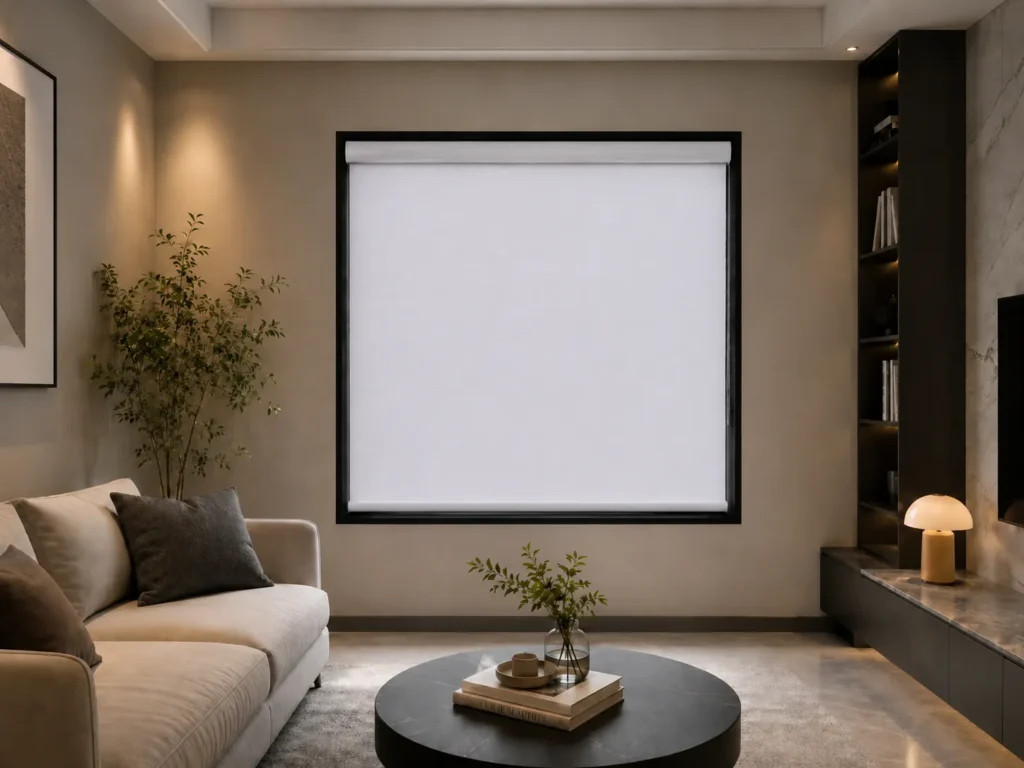
A single flat panel of fabric, so the light through it is very even. Our roller collections include light filtering fabrics such as DuneLoom, an oat linen texture chosen to reduce glare without feeling heavy, and MoonVeil, a softly textured lavender fabric. Rollers also offer the Dual Roller System, which pairs a daytime light filtering fabric with a stronger privacy or room-darkening fabric on one bracket. See all fabrics on our custom roller blinds page.
Zebra blinds
Every fabric in our zebra blinds range is dual-layer and light filtering. Alternating sheer and solid bands slide past each other: line the sheer bands up for a brighter room and a partial view, or overlap the solid bands for more privacy. Zebra blinds are not a blackout product; for a bedroom that needs real darkness, pair one with a room-darkening roller or cellular blind. Our zebra vs roller comparison covers the trade-offs in more detail.
Cellular blinds
Light passes through two faces of fabric with an air pocket between, so the glow is especially soft and diffused. Our cellular blinds come in light filtering and room-darkening fabrics, and the honeycomb also helps with comfort near cold glass. They suit bedrooms where you want gentle morning light rather than full darkness, and colder rooms generally.
| Blind type | Light filtering look | Adjustability | Can add darkness later? |
|---|---|---|---|
| Roller, light filtering fabric | Flat, even glow | Raise or lower | Yes, with a Dual Roller System |
| Zebra (all fabrics light filtering) | Striped light, partial view when open | Raise, lower, or shift the bands | Pair with a separate room-darkening blind |
| Cellular, light filtering fabric | Very soft, diffused | Raise or lower | Choose room-darkening fabric for that window instead |
Room-by-room: where light filtering blinds fit
| Room | Light filtering? | Why | Suggested setup |
|---|---|---|---|
| Living room | Yes | Keeps the room bright, cuts winter glare on the TV and sofa | Zebra or light filtering roller |
| Kitchen | Yes | Daylight for cooking, privacy from the yard | Light filtering roller in a wipeable fabric |
| Home office | Yes | Lowers screen glare without switching on lights | Mid-tone or darker light filtering roller |
| Dining room | Yes | Soft light at meals | Zebra or light filtering cellular |
| Bedroom | Only with a second layer | Light filtering alone lets in early sun | Dual roller, or room-darkening cellular |
| Nursery | Usually no | Daytime naps need a dim room | Room-darkening fabric, cordless or motorized |
| Street-level or close-neighbour room | By day only | Silhouettes show at night | Dual roller, or zebra plus a room-darkening layer |
| Bathroom | Yes, with care | Light without a view in | Moisture-resistant light filtering fabric; check night privacy |
For kitchen and bathroom fabrics, see our guide to waterproof kitchen and bathroom blinds. For bedrooms, the room darkening guide is the better starting point.
How to test a light filtering fabric sample at home
A sample held up in a showroom tells you little about your own window. This test takes two short sessions:
- Get samples of two or three light filtering fabrics in different tones, plus one room-darkening fabric for comparison.
- On a sunny day, at the hour the sun hits the window hardest, tape each sample to the glass.
- Sit where you normally sit (desk, sofa, kitchen counter) and look at the sample. Is the glow comfortable, or does the fabric itself look too bright?
- Check the colour of the light on your walls. Warm fabrics tint the room; cool greys keep it neutral.
- After dark, turn on your usual evening lights and look at the window from outside. If you can see shapes through the sample, plan a second layer for that room.
Try the fabric at your own window first. Request a free fabric sample of the light filtering fabrics you are considering, or request a quote once you have picked one. In Ottawa, you can also book a free consultation.
Common mistakes with light filtering blinds
- Expecting a dark bedroom. Light filtering fabric lets the sunrise in, and around the June solstice the sun comes up at about 5:15 a.m. in Ottawa (our calculation, daylight time).
- Choosing bright white for a sunny desk. In direct sun, a white fabric becomes a bright panel beside your screen. A mid-tone is usually more comfortable.
- Judging the fabric in summer. The high June sun barely enters the room. Test in the low autumn or winter sun if you can, since that is when glare is worst.
- Forgetting the edges. An inside-mount blind leaves thin strips of light at each side. On a glare-prone window, an outside mount with overlap cuts those strips. Our inside vs outside mount guide explains the trade-off.
- Assuming it will stop fading. Visible light fades fabrics and finishes too, so lower the blind during direct sun hours on furniture you care about.
- Using one fabric for every window. North windows rarely need glare control; south and west windows usually do. Match the fabric to the window, not the house.
Cord safety with any blind
Light filtering blinds are often chosen for family rooms, so cord safety applies. Canada’s Corded Window Coverings Regulations (SOR/2019-97), in force since May 1, 2021, limit a reachable cord with one free end to 22 cm when pulled with a force of 35 N, and limit any loop to a 44 cm perimeter. The definition of “cord” includes chains. Health Canada reports that before the change, an average of one child per year died from strangulation by a window covering cord, that children aged 1 to 3 are most at risk, and it advises never placing cribs, beds or playpens near a window where a child could reach a cord (Health Canada, Window covering safety).
Our roller, zebra and cellular blinds are offered with manual chain, cordless and motorized control. In children’s rooms, motorized control removes the reachable chain altogether. More detail is in our cordless blinds safety guide.
Planning a whole living room rather than one window? Our guide to blinds for living room windows works through window direction, TV glare and evening privacy.
Frequently asked questions about light filtering blinds
Do light filtering blinds provide privacy?
Yes in the daytime, partly at night. When it is brighter outside than inside, light filtering blinds hide the room well. With lights on after dark, people outside can see silhouettes, so add a room-darkening layer where night privacy matters.
Are light filtering blinds see-through?
Not clearly. From inside you see light and blurred shapes rather than a sharp view. Darker light filtering fabrics show more of the outside than pale ones; sheer and screen fabrics are the ones built for a view.
What is the difference between light filtering and room darkening blinds?
Light filtering blinds soften daylight and keep the room bright. Room darkening blinds block much more light for sleep or screens, though not 100%. Pick by what the room is used for during the day.
Are light filtering blinds good for bedrooms?
Only if you like waking with the light. On their own they let in early sun, which comes very early in a Canadian summer. A dual roller or a room-darkening cellular blind is usually the better bedroom choice.
Do light filtering blinds stop furniture from fading?
They reduce fading but do not stop it. The Canadian Conservation Institute notes that UV usually causes less than half of the fading of light-sensitive colours, so visible light matters too. Lowering the blind during direct sun hours helps most.
Are zebra blinds light filtering?
Yes. Every Zenith Shade zebra fabric is dual-layer and light filtering. Overlapping the solid bands adds privacy, but a zebra blind will not darken a room the way room-darkening fabric does.
What colour light filtering blinds reduce glare best?
Mid-tone to darker colours usually. A 2024 Berkeley study found that darker fabrics of the same light transmittance gave clearer vision and more view satisfaction, while very pale fabrics glow brighter in direct sun. White and ivory suit north-facing or darker rooms.
Can light filtering blinds be motorized?
Yes. Motorization is available across our roller, zebra and cellular lines, so a light filtering blind can lower on a schedule during the hours the sun hits a desk or TV.
Light filtering blinds: the short version
- Light filtering blinds keep a room bright, blur the view in and cut glare. They do not darken a room.
- They matter most on south and west windows in winter, when Ottawa’s noon sun is only about 21° high and reaches deep into the room.
- Colour changes the result: pale fabrics glow and hide more, darker fabrics show more view and feel calmer.
- Night privacy is partial. Use a dual roller or a second room-darkening blind where it matters.
- Test samples at your own window in sun and after dark before you order. Browse all options on our custom window blinds page.
Scope: this guide reflects Zenith Shade’s product range and the sources linked above as of October 2026. Sun angles are calculated for Ottawa at solar noon and are approximate for other Canadian cities. Nothing here replaces the cord-safety requirements set out in SOR/2019-97.