Official sources verified on October 25, 2026
Privacy blinds are window coverings chosen to stop people outside from seeing in, and the ones that work after dark are opaque: room-darkening roller or cellular fabric, or a dual roller with an opaque back layer. Light-filtering fabrics, sheer bands and open-weave screens give good daytime privacy, but once your lamps are brighter than the street they show shapes and movement to anyone outside. For a room that needs daylight and night privacy, plan two settings: a light-filtering position for the day and a fully opaque one for the evening.
That night-time switch matters more in an Ottawa winter than most people expect. Below you will find why it happens, what independent research says about fabric openness and colour, how each blind type compares, and how to test a sample at your own window before you order.
Privacy blinds at a glance
| Blind and fabric | Daytime privacy | Night privacy with lights on | Daylight let in | Good fit for |
|---|---|---|---|---|
| Roller, room-darkening fabric | Full | Full (edge gaps aside) | Very little when closed | Bedrooms, street-level rooms, bathrooms |
| Roller, light-filtering fabric | Good: shapes blurred | Partial: silhouettes visible | Soft, even light | Living rooms, kitchens, offices by day |
| Roller, open-weave screen fabric | Partial: depends on openness and outside brightness | Low: room visible at night | High, with a view out | Glare control in offices and sunrooms |
| Zebra, bands overlapped (closed) | Good | Partial: the fabric is light filtering | Filtered | Living and dining rooms |
| Zebra, bands aligned (open) | Low | Low | High through the sheer bands | Daytime view |
| Cellular, light-filtering | Good | Partial | Soft, diffused | Bedrooms that want morning light, colder rooms |
| Cellular, room-darkening | Full | Full (edge gaps aside) | Very little when closed | Bedrooms, nurseries, street-facing rooms |
| Dual roller (day fabric + opaque fabric) | Choice of either layer | Full on the opaque layer | Your choice | Rooms that need both, all year |
Why privacy blinds behave differently at night
The short version: you are only hidden when your side of the fabric is darker than the outside. Glass and thin fabric both let some light through and bounce some back. The University of Illinois physics Q&A service explains it with a two-way mirror: “If the room on one side is brightly lit and the other side is dimly lit, the people in the dark side can see those on the bright side but not vice-versa” (University of Illinois Physics Van).
A light-filtering blind follows the same rule. At noon the street is far brighter than your living room, so passers-by see a glowing panel of fabric and very little behind it. At 6 p.m. in December the street is dark and your lamps are on. Now the room is the bright side, light pushes outward through the weave, and anyone on the sidewalk sees outlines, the TV and people moving around. The fabric has not changed. The balance of light has. For the daytime side of this, see our guide to light filtering blinds.
Bare glass does the same thing. After sunset you see your own reflection in the window and assume nobody can see in, when the opposite is true: the reflection is a sign that your room is the bright side.
How many dark hours an Ottawa window has to cover
Ontario clocks fall back one hour on Sunday, November 1, 2026 at 2 a.m., according to blogTO’s 2026 daylight saving time report. Using standard solar-position calculations for Ottawa (45.42° N), sunset moves from about 5:51 p.m. on October 31 to about 4:49 p.m. on November 1, and reaches its earliest, about 4:19 p.m., around December 10.
| Date (Ottawa) | Sunrise (approx.) | Sunset (approx.) | Hours of darkness |
|---|---|---|---|
| October 31, 2026 | 7:41 a.m. | 5:51 p.m. | About 13 h 50 min |
| November 1, 2026 (clocks fall back) | 6:42 a.m. | 4:49 p.m. | About 13 h 53 min |
| December 1, 2026 | 7:22 a.m. | 4:20 p.m. | About 15 h 2 min |
| December 21, 2026 (shortest day) | 7:39 a.m. | 4:22 p.m. | About 15 h 18 min |
| June 21, 2026 (for comparison) | 5:14 a.m. | 8:54 p.m. | About 8 h 20 min |
On the shortest day an Ottawa window spends roughly 15 hours in darkness, and the whole evening at home falls inside them. A blind that only hides the room in daylight covers the shorter part of a December day.
Fabric openness and colour: what the research shows
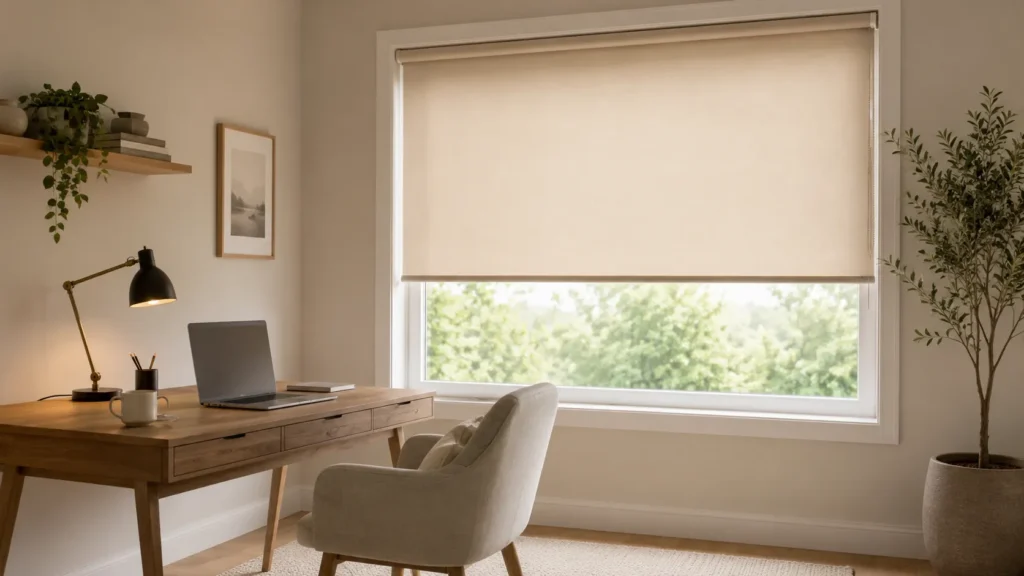
Openness factor is the percentage of a fabric that is open weave. It governs how much you can see through the fabric, and fabric colour changes that picture more than most shoppers expect. A University of Nebraska-Lincoln researcher, Iason Konstantzos, summarised a view-clarity study of 18 people looking through 14 roller shade fabrics in daylight, at 1 m and 2.4 m from the window, under sunny and cloudy skies (View Clarity towards Visual Satisfaction, CBE symposium, 2021). The underlying paper is Konstantzos et al., “View clarity index,” Building and Environment, 2015.
| Fabric in the study | Measured openness | Rank for view clarity (1 = clearest of 14) | Clarity score (0 to 1) |
|---|---|---|---|
| Black | 11.3% | 1 | 0.893 |
| Black | 7.0% | 2 | 0.817 |
| Black | 3.7% | 3 | 0.730 |
| Grey | 12.6% | 4 | 0.682 |
| White | 12.5% | 5 | 0.585 |
| Black | 2.6% | 8 | 0.527 |
| White | 5.9% | 10 | 0.298 |
| White | 1.6% | 13 | 0.026 |
| Grey | 0.7% | 14 | 0.013 |
Two findings stand out. The three clearest fabrics were all black, and a black fabric at 2.6% openness ranked above a white one at 5.9%. And openness still matters: the white and grey fabrics below 2% left almost no usable view.
What the study does not measure is the view in, or anything at night. Use it to judge how much of the outdoors you keep by day. For evening privacy, the earlier rule still decides: any fabric with open weave or a light-filtering face will show a lit room. If you want the daytime view of a dark open-weave fabric, pair it with an opaque layer for the evening. Our guide on whether blinds block UV rays covers the other side of openness: how much sun gets through each weave.
How each blind type handles privacy
Zenith Shade makes roller, zebra and cellular blinds, all of which can be motorized. Each one handles the day-to-night problem in a different way.
Roller blinds: the simplest route to full night privacy
A roller blind is a single sheet of fabric, so its privacy depends almost entirely on the fabric you pick. Our custom roller blinds come in light-filtering and room-darkening fabrics. Room-darkening fabric stops the view in at any hour. Light-filtering fabric softens daylight and blurs shapes by day, but shows silhouettes at night.
For rooms that need both, the roller page lists a Dual Roller System, which pairs a daytime light-control fabric with a stronger privacy or room-darkening fabric on one window. You lower the light fabric in the morning and the opaque one at dusk.
Zebra blinds: daytime privacy you can adjust without raising the blind
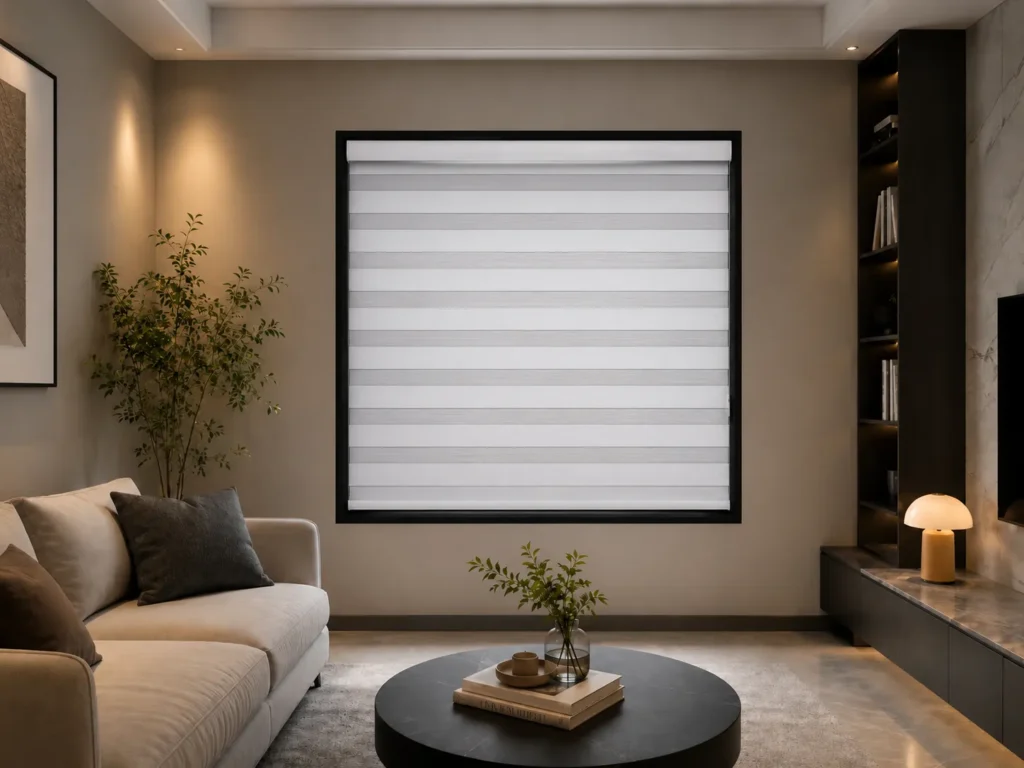
Zebra blinds layer sheer and solid bands. Slide the bands so the solids overlap and the window is covered; slide them so the sheers line up and you get light and a filtered view. Every zebra blind fabric we carry is dual-layer and light filtering, so treat zebra blinds as a strong daytime privacy choice and a partial one at night. In a street-facing living room that is lit in the evening, a zebra blind on its own will still show movement. Our zebra vs roller comparison goes deeper on that trade-off.
Cellular blinds: privacy plus insulation
Cellular blinds are pleated honeycomb fabric with a slim headrail. The cellular blinds range comes in light-filtering and room-darkening fabrics. The light-filtering version diffuses daylight evenly and hides detail well during the day; the room-darkening version gives full privacy at night. Because the cells trap air, they are a good fit for bedrooms on cold exterior walls, which our thermal blinds guide covers with test data.
Motorization: making the evening switch automatic
The best privacy blind fails if nobody lowers it. With motorized blinds you can set a timer or app routine to close street-facing windows before your lamps come on, then shift the time when the clocks change on November 1. Our motorization page lists app and timer routines for “morning light, evening privacy, or bedroom comfort.” Our smart blinds compatibility guide explains which home systems can run those schedules.
Privacy blinds that let light in during the day
Privacy blinds that let light in exist, but only for daytime. Pick by how much view you want to keep:
- Most light, least view in: a light-filtering cellular or roller fabric in a light colour. It glows evenly and hides detail well while the outside is brighter.
- Light plus some view out: a zebra blind with the bands partly offset, or a dark open-weave roller fabric if seeing the yard matters more than hiding the room.
- Light by day, full privacy at night: a dual roller, or a light-filtering blind combined with a room-darkening one on the same window.
Before you accept a single light-filtering fabric as round-the-clock privacy, check it on a lit window at night, using the test below.
Edge gaps: where privacy leaks even with an opaque fabric
Opaque fabric does not help if people can see past the sides of it. An inside-mounted blind sits within the window opening, and our window shade measuring guide notes it “can leave a small side light gap depending on fabric and product type.” At night those slivers glow, and from close to the window someone can see into the room through them.
Outside mount fixes this by covering the frame. The measuring guide states that many rooms benefit from 1.5 to 3 inches of overlap on each side. For a ground-floor window beside a sidewalk, the upper end of that range is the safer choice.
Worked example: sizing an outside-mount privacy blind
| Step | Value | Note |
|---|---|---|
| Window opening (inside trim) | 36 in wide | Measured to the nearest 1/16 in at top, middle and bottom |
| Privacy overlap per side | 3 in | Upper end of the 1.5 to 3 in range in our measuring guide |
| Total blind width | 36 + 3 + 3 = 42 in | Check nearby walls, handles and trim projection first |
| Same window with 1.5 in overlap | 36 + 1.5 + 1.5 = 39 in | Acceptable on upper floors or windows set back from the street |
If the window has handles or cranks, or the frame is shallow, outside mount may be the only practical option anyway. Our inside vs outside mount guide walks through both, and the room darkening vs blackout guide explains where light gets in around a closed blind.
Room-by-room: which privacy blinds to choose
| Room | Main privacy problem | Suggested setup |
|---|---|---|
| Street-facing living room | Lit in the evening, visible from the sidewalk | Zebra or light-filtering roller for the day, plus an opaque layer (dual roller) or a room-darkening fabric closed at dusk; outside mount with generous overlap |
| Bedroom | Night privacy and early light | Room-darkening roller or cellular; see our room darkening vs blackout guide |
| Bathroom | Privacy at all hours, plus humidity | Room-darkening fabric that can be wiped clean; our kitchen and bathroom blinds guide covers moisture |
| Home office | Glare by day, video calls in the evening | Light-filtering or dark open-weave roller for daytime, with an opaque layer for evening calls |
| Condo facing another tower | Neighbours at eye level, day and night | Light-filtering by day, opaque at night; check building rules on backing colour in our condo window covering rules guide |
| Basement | Windows at ground level, sometimes facing a neighbour’s yard | Room-darkening or light-filtering cellular depending on daylight needs; our basement window blinds guide covers shallow frames |
| Nursery | Night privacy and cord safety | Room-darkening fabric with cordless or motorized control (see the safety section below) |
How to test a privacy blind sample at night
A sample in daylight tells you about colour and texture. A sample at night tells you about privacy. Here is the test we suggest:
- Ask for samples of the fabrics you are considering, including at least one room-darkening option.
- After dark, tape a sample to the inside of the window you want to cover.
- Turn on the lights you normally use in that room in the evening, including any lamp close to the window.
- Go outside and stand where a neighbour or passer-by would be: the sidewalk, the driveway, the building across the courtyard.
- Look for shapes, colours and screen glow behind the sample. If you can see them at that distance, so can everyone else.
- Repeat the next morning from inside to check how much light and view each sample keeps.
Order samples before you choose. Request a free fabric sample and run the night test at your own window, or request a quote once you know which fabric passes.
Common privacy blind mistakes
- Judging privacy at noon. Daytime tells you almost nothing about the evening. Test after dark.
- Choosing a sheer or zebra blind for a street-level bedroom. It will show movement at night unless paired with an opaque layer.
- Inside mount on a ground-floor window without checking side gaps. The gaps are small, but at night they are lit from inside.
- Assuming a dark fabric is more private. In the Konstantzos study, dark fabrics gave the clearest view through the weave. That helps the view out by day; it does not hide a lit room at night.
- Forgetting the clock change. After November 1, sunset in Ottawa is before 5 p.m. Move motorized schedules forward the same weekend.
- Leaving long cords in a child’s room. Privacy blinds go in bedrooms, which is exactly where cord safety rules matter most.
Cord safety for privacy blinds in bedrooms and nurseries
Privacy blinds often end up in bedrooms, so check the controls as carefully as the fabric. Health Canada states that before the 2021 rules, “an average of one child per year died from strangulation by a window covering cord,” and that children between 1 and 3 years old are most at risk (Health Canada, Window covering safety, updated September 17, 2025). It also advises: “Never place cribs, beds, and playpens near a window where a child could reach a cord.”
Under the Corded Window Coverings Regulations (SOR/2019-97), in force since May 1, 2021, an accessible cord must not exceed 22 cm when pulled with a 35 N force, and any loop must not exceed 44 cm in perimeter. The definition of “cord” includes chains. Health Canada notes the rules apply to all window coverings sold in Canada, custom-made and off the shelf.
Our roller, zebra and cellular blinds can be ordered with manual chain, cordless or motorized control. For a child’s room, cordless or motorized is the simpler choice. Our cordless blinds safety guide covers the rules in more detail.
Frequently asked questions about privacy blinds
What are the best privacy blinds for a street-facing room?
Room-darkening roller or cellular blinds, mounted outside the frame with 1.5 to 3 inches of overlap per side. If you also want daylight, add a light-filtering layer with a dual roller or pair a zebra blind with an opaque one.
Can people see through blinds at night?
Yes, through light-filtering, sheer and open-weave fabrics when your room is brighter than outside. Room-darkening fabric does not show the room, although small edge gaps can still glow.
Are there privacy blinds that let light in?
Yes, for daytime. Light-filtering cellular and roller fabrics, and zebra blinds with the bands overlapped, let soft light in while hiding detail. They lose most of that privacy after dark with the lights on.
Do zebra blinds give full privacy?
Not at night. With the solid bands overlapped they give good daytime privacy, but the fabric is light filtering, so a lit room shows outlines from outside. Pair them with an opaque layer in street-facing rooms.
Are cellular blinds good for privacy?
Yes, especially in room-darkening fabric, which blocks the view at any hour. Light-filtering cellular fabric gives good daytime privacy and partial night privacy, and both versions add insulation.
Does fabric colour affect privacy?
It changes how much you can see through an open weave. In a 2021 summary of view-clarity research, black fabrics gave the clearest view out in daylight. For night privacy, opacity matters more than colour.
Is inside or outside mount better for privacy?
Outside mount. It covers the frame and removes the side gaps an inside-mount blind can leave. Our measuring guide suggests 1.5 to 3 inches of overlap on each side.
Do motorized blinds help with privacy?
Yes, because they close on schedule. Set street-facing blinds to lower before your evening lights go on, and move the schedule earlier after the November 1 time change.
Privacy blinds: the short version
Choose privacy blinds for the hours that matter. Light-filtering, zebra and open-weave fabrics give good privacy while it is bright outside, but only an opaque fabric hides a lit room after dark, and Ottawa windows face about 15 hours of darkness around the winter solstice. Combine a day fabric with an opaque one where you need both, mount outside the frame where privacy is critical, and test a sample at night before you order. Browse all custom window blinds, or book a free consultation and we will look at each window with you.
Scope: this guide covers interior window coverings for homes in Canada, as of October 2026. It does not cover exterior privacy screens, window film, curtains or shutters, which Zenith Shade does not sell. Sunrise and sunset times are calculated estimates for Ottawa. Research figures come from the sources linked above and were measured under specific conditions.